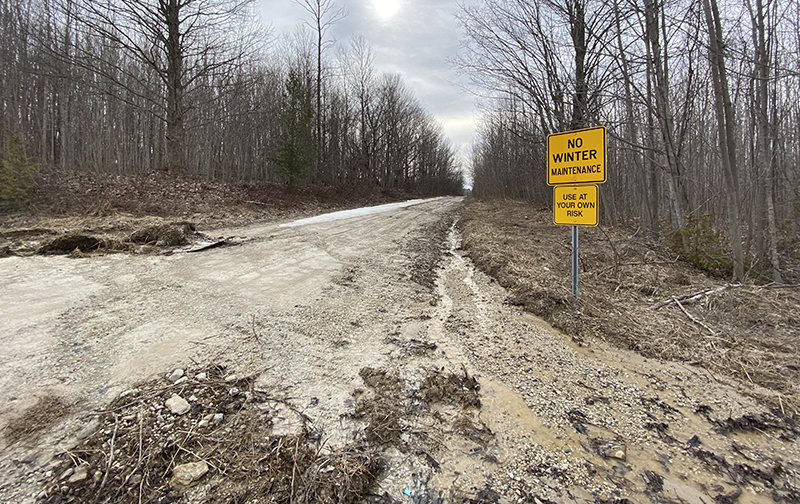
Expert supports claim roadwork has been misclassified
Donnelly Law has circulated a witness statement in support of the reclassification of the proposed construction upgrades to the 26/27 Sideroad to the Environmental Assessment Branch of the Ministry of the Environment, Conservation and Parks, Clearview Township, and the media on behalf of clients Wendy Franks and David Stevenson and their allies at Blue Mountain Watershed Trust, who continue to fight against the closure of County Road 91.
A hearing with regards to the proposed reconstruction of 26/27 Sideroad was adjourned indefinitely after the classification of the project under the Environmental Assessment (EA) Act came into question. The witness statement of Mark Heaton, retired fish and wildlife biologist who worked for the Ministry of Natural Resources and Forestry from 1992-2020, was shared with the tribunal prior to adjournment.
At the core of the argument is the classification of the construction project. If the project has been misclassified as Schedule A+ rather than as Schedule B or C, the project would not be exempt from the requirements of the Environmental Assessment Act.
“The bottom line for Mr. Heaton is that based on his review of the Environmental Impact Statement prepared by R.J Burnside for the township and provided to the Ministry, ‘there will be significant adverse environmental effects on fish, fish habitat, wetlands, wildlife and species-at-risk.’ In addition, it is his opinion that the road widening proposed by the township is consistent with a Municipal Class Environmental Assessment Schedule “C” undertaking, not Schedule A+,” writes David Donnelly in a letter to Clearview Mayor Doug Measures, dated Feb. 11. “Inexplicably, Clearview has taken the position that the project is a Schedule A+, meaning that it is your position that the roadway expansion will be ‘limited in scale, [and will] have minimal adverse environmental effects.’”
Donnelly asserts the privatization and closure of County Road 91 is a “betrayal of public trust” and has not had “an open and transparent process to establish whether it is in the public interest.”
In the witness statement, Heaton makes 17 conclusions in support of a 2016 site report that found “redevelopment and expansion of this seasonal road has the potential to further reduce the quantity and quality of aquatic habitats within and downstream of the road corridor” and questions a 2018 Environmental Impact Study’s (EIS) lack of site specific design recommendations and mitigation measures for avoiding and minimizing destruction of a provincially significant wetland, preventing wildlife mortality, including species-at-risk, and protecting and maintaining groundwater discharge from the road bed to the streams.
“It is my opinion, based on the review of the EIS and preliminary design drawings, that there will be significant adverse environmental effects on fish, fish habitat, wetlands, wildlife and species-at-risk as a result of this project as currently designed. It is my opinion that the EIS lacks an assessment of alternative road designs to avoid or minimize loss of wetlands, fish habitat, and woodlands supporting species-at-risk,” writes Heaton.
“From an ecological perspective, the best and most obvious alternative option is to decommission the steep-gradient central section of 26/27 Sideroad where it descends over the Niagara Escarpment. This would allow for the restoration of natural stream channels in this area, increasing both the quality and quantity of fish habitats. Expansion of the road would have the opposite effect,” he concludes.