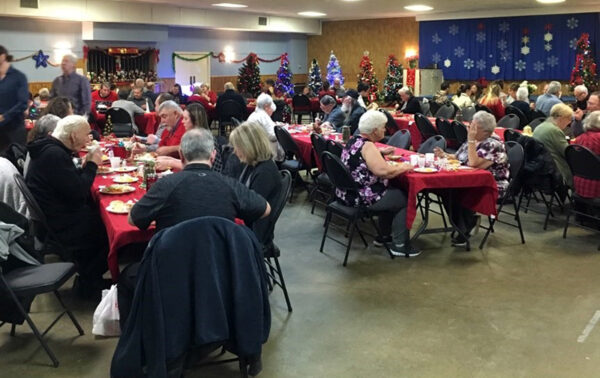
Everyone knows that drag shows are a good time – solidly confirmed by most of the 300 people who attended the Drag Me to Creemore show at the Legion Friday night, and firmly suspected by the 150-plus people on the waiting list.
Purple Hills Arts and Heritage Society booked the drag queens for the Friday show as part of the event committee’s mission to talk about art in new ways and invite other communities (not just white heterosexual communities) to tell their stories through art.
The drag show was an incredible success, with a crowd that participated with extreme enthusiasm, love and respect.
The queens are deeply talented performers, perfecting hair, make-up, costuming, choreography, stand-up comedy and lip synching, to name just a few of their obvious talents.
But drag is so much more than meets the eye, as we had the privilege of learning from Justine d’As/ Mitchell LaFramboise, during Drag 101 on Saturday.
Justine taught us that drag has evolved over centuries and has been used as a form of expression and protest against pivotal moments in the gay community’s history including oppression, police violence, AIDS, and its explosion into pop culture.
Drag is an acronym for dressed resembling a girl, a term that dates back to the 16th Century when women were not allowed on stage and men played all the female parts.
Since then drag queens and kings have been performing and pushing gender boundaries.
Justine gave us an insider’s look into the world of drag. Like others, she belongs to a house system. Justine explained that houses were established to provide a sense of family to those who have been kicked out of the house by families disapproving of their sexual orientation. She said the system has its roots in New York City, where it still exists, and each house has a mother, someone who mentors the up and coming drag queens and teaches them the tricks of the trade.
Justine also put in context the modern day Pride Parade movement against the backdrop of the traumatic Toronto bathhouse raids of 1981, when people were beaten and arrested by police for congregating in the city’s gay village. In February of that year, a series of bathhouse raids in Toronto called Operation Soap resulted in the second- largest mass arrest in Canadian history. This ignited decades of protests against police brutality toward a community that was already targeted violently by others in the community and had no where to turn for protection.
This all made us realize that drag is a party scene and a celebration of beauty but there is so much more to it.
It was an honour to be educated by someone who has a reverent understanding of the history and culture of the art form.