by Cecily Ross
As I look out over my winter garden, the last things I am reminded of are butterflies and bees. And yet, beneath the expanse of whiteness, I know that tiny critters, insects and larvae, of all description, are sleeping soundly in a protective bed of unraked leaves. Poking up through the blanket of snow I see the dried remains of native and naturalized plants — purple cone flower, bee balm, the wispy skeletons of goldenrod and wild aster, sedum, and Queen Anne’s lace — plants I left standing after they died back in the fall. Their seed heads attract and sustain gold finches, chickadees, and juncos, among other birds. The fruits of high bush cranberry, staghorn sumac, and crab apple trees also provide birds with food through the long winter months.
The science tells us that growing plants that support birds, butterflies, bees and other insects, and creating environments friendly to their survival is vital to the health of our planet and to preserving the very food we eat. To that end, municipalities in places such as Toronto, Collingwood, and Barrie, to name only a few,have reframed their property maintenance bylaws to reflect these new and urgent realities. The standard of the post-war manicured turf-grass lawn and garden is on the wane as enthusiasm for naturalized gardens grows. However, the debate over the safety and aesthetics of boulevard and pollinator gardens is ongoing. And nowhere more so than here in Clearview Township where the bylaws regarding property maintenance are vague and out of date.
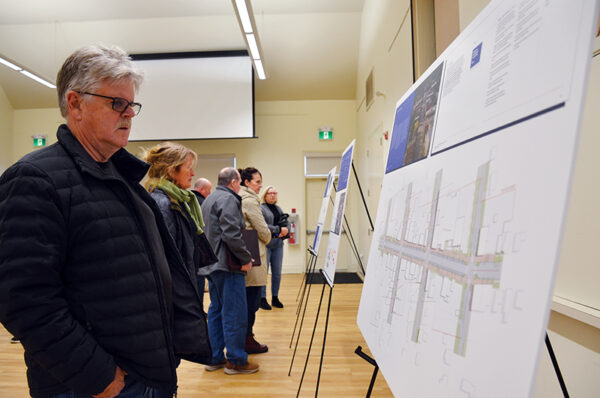
On Feb. 6, the Clearview Sustainability Network (CSN) is holding a panel discussion at Creemore Station on the Green entitledBoulevards, Bylaws, Butterflies and Birds: Supporting Biodiversity in Clearview Township.
The panel will include author and biodiversity activist Lorraine Johnson; Shannon Stevens from the Nottawasaga Valley Conservation Authority; Brenna Lattimore, a local property owner and environmental scientist; Amy Cann, Clearview’s Director of Planning and Building; and Dan Perreault, Clearview’s Director of Public Works.
In the words of master gardener and Creemore Horticultural Society member Christine March in her recent address to council: “When I was first starting out 40 years ago gardens were all about conformity – manicured lawns, stately trees, clipped shrubs, and pretty flowers. Gardening concepts such as biodiversity, environmental awareness, and pollinator-friendly were unknown.” She went on to urge council members and the public to attend the Feb. 6 event saying, “The fact that insect populations are in serious declinearound the world is a grave matter that should concern us all.”
The catalyst for this ongoing discussion is a conflict over a wildflower garden that Lattimore planted on the boulevard in front of her Creemore home. Citing safety issues and sight lines, the township obliged Lattimore to cut back her native plants to 30 cm. Lattimore, with the backing of CSN, took her case to council and the public.
CSN’s position is that the township has no apparent policy or guidance regarding gardening on the boulevard. And that Clearview property bylaws covering private property maintenance use vague, subjective language, referring to “weeds” without specifying what is or isn’t a weed. The laws require properties to be “neat” and “tidy,” prohibit “long grass,” “dead wood,” the harbouring of “annoying insects,” “excessive herbage,” and “untrimmed underbrush” without providing clear definitions. In a deputation being prepared by CSN’s biodiversity committee, the group argues that terms used in the bylaws such as “attractive” and “unsightly” are highly subjective, and that the resulting lack of specificity invites arbitrary enforcement. The deputation goes on to suggest ways in which the two bylaws in question can be rewritten to provide clarity and to accommodate the benefits of naturalized gardens.
The efforts of CSN coincide with the wider national “Bylaws for Biodiversity” campaign launched last July by the David Suzuki Foundation, the Canadian Wildlife Federation, the Canadian Institute of Landscape Ecologists, the Ecological Design Lab at Toronto Metropolitan University, andauthor Lorraine Johnson. The campaign advocates for municipalities across the country to reform.
As well, Clearview’s existing policies regarding boulevard gardens may be a violation of the Charter of Rights and Freedoms. In a 1996 ruling (Bell vs. Toronto), the courts struck down bylaws enforcing conventional landscaping (i.e. turf grass lawns). Boulevard gardens, the court declared, are a way for property owners to express their pro-environmental beliefs and as such are protected as freedom of expression under the Charter.
The Feb. 6 Boulevards, Bylaws, Butterflies and Birds event promises to be an informative and lively conversation and, the organizers hope, will help forge a path forward on this timely and crucial issue. Doors open at 6:30 p.m., panel discussion begins at 7 p.m. Snacks will be provided. Bring your own beverage. Donations are welcome.
Cecily Ross is a member of the Clearview Sustainability Network’s biodiversity working group.