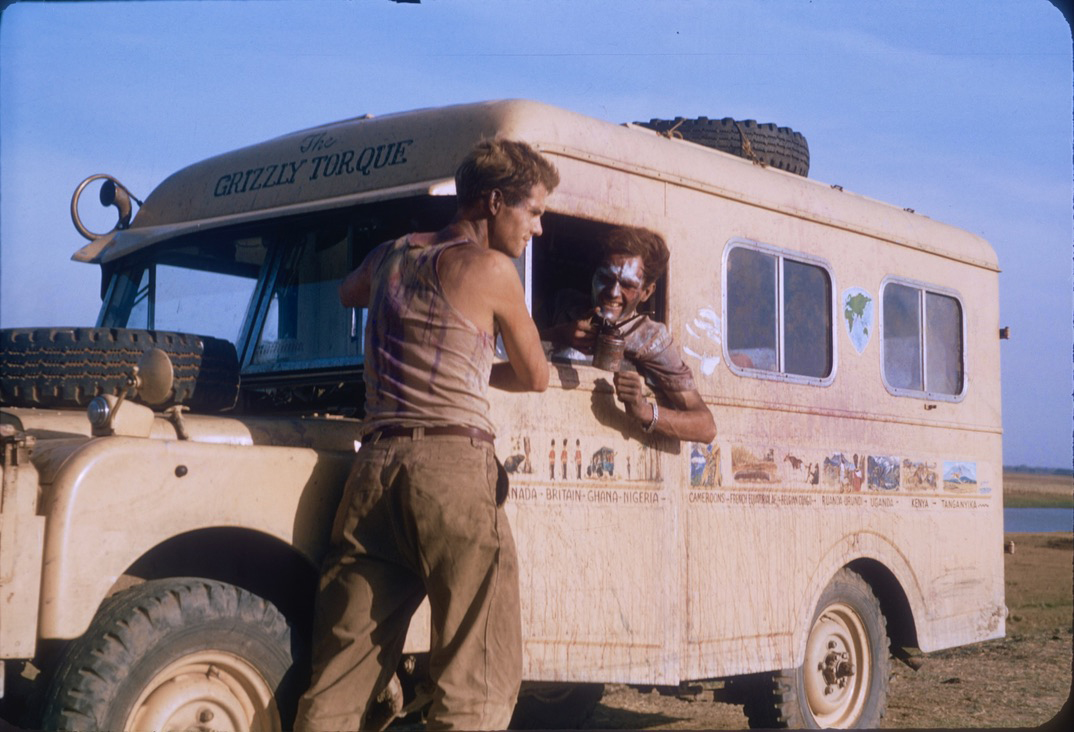
Wildlife artist Robert Bateman and biologist Bristol Foster, whose 1957 global expedition in a Land Rover they called “The Grizzly Torque” sparked a lifelong friendship and helped shape early environmental storytelling in Canada through art and science.
Alison Reid did not set out to become a documentary filmmaker. As a child, she craved excitement and found school boring and frustrating. At age 17 she landed her first gig as a stunt woman in an episode of Canadian classic The Littlest Hobo, and went on to rack up over 300 TV and movie stunt credits, and become only the second female stunt coordinator in North America.
“As a stunt coordinator, I found myself dealing with actors, camera people, props and special effects to choreograph stunts, and I figured out I wanted to be more involved in the story telling,” she told The Echo.
Reid made the transition to directing a number of years ago, and now directs episodic TV, and what she refers to as her passion projects through her company Free Spirit Films.
In 2018, she decided to tell the story of Anne Innis Dagg, a Canadian woman who travelled to South Africa in 1956 to study giraffes in the wild. The Woman Who Loves Giraffes won critical acclaim for Reid, and shone a spotlight on Dagg. In spite of her ground breaking work with giraffes, and years teaching at Canadian universities, Dagg was unable to get tenure – a victim of the sexism that existed in academia. After she retired from teaching she was given the Order of Canada and several honourary degrees.
It was through her work on The Women Who Loves Giraffes that Reid was first introduced to wildlife artist Robert Bateman and biologist Bristol Foster, the subject of her newest film, The Art of Adventure.
Dagg, Bateman and Foster all attended University of Toronto in the 1950s. Foster and Dagg were in the same biology class and later collaborated on the book that would become known as the bible on giraffes. Bateman was Dagg’s first boyfriend.
“I met them (Bateman and Foster) on Salt Spring Island where they both lived while I was working on The Women Who Loved Giraffes,” says Reid. “At that point, I had no intention of doing another documentary. It’s very labour intensive. You have to be grabbed very deeply to have the tenacity and fortitude to put in the work.”
Being in their presence very calming, she found, and determined that the story of their epic round-the-world adventure needed to be told.
Bateman and Foster set off in 1957 in a Land Rover they named “Grizzly Torque” and eventually covered more than 30,000 kilometres on an adventure where nature, art and activism intersected. Theirs is the story of two very different men, one an artist and one a scientist, who fought together to protect the natural world. Over a period of 18 months, they travelled through Africa, the Indian Subcontinent, Southeast Asia and Australia, with Bateman sketching and painting every step of the way and Foster chronicling their travels with his 16 mm camera.
Much of that original footage makes its way into The Art of Adventure, currently playing at the Blue Mountain Film Festival. It is supplemented with footage and interviews with Bateman and Foster, both now in their 90s.
“They embraced our crew coming into their homes and both families were so open with us,” she said. “At the heart of the film this is about the passing of the torch to a younger generation. They both believe that in order for good to be done in protecting our environment, young people must actually connect with nature, not just through screens but by getting out there, and that something fundamentally must change if we are to survive a species.”
“They are inspiring glass half full guys who love to point out that the minute we stop polluting and decimating mother nature, she begins to regenerate. People tend to leave this film feeling happy.”
The Art of Adventure is airing at noon on Sunday, May 31, in the Huron Theatre at Village Conference Centre at Blue Mountain Resort. Reid will be in attendance for a Q&A.
The Blue Mountain Film Festival, May 28-31 features 33 films representing 16 countries. The complete line- up and tickets are available at bluemtnfilmfest.ca.