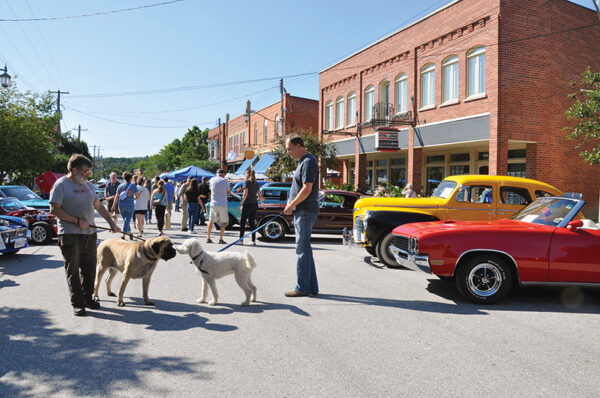
County Road 9 between Creemore and Dunedin has become a very busy highway. Perhaps
A look at what this road was like many years ago will bring a refreshing perspective. These reminiscences are from the pen of G. A. Royal, who spent his boyhood days on the farm at the western side of Creemore. Today it is a farm no longer but the site of several residences.
The story, written in the present tense, describes a trip from Creemore to Dunedin by a 10-year old boy, made about 1900.
Dolly has gone lame. Her hoof is giving her trouble again and she needs a new shoe; a shoe of special fitting that only Ezra Bloomer the blacksmith at Dunedin, seems to have the knack to get just right. Now, Dolly is our driver, and a very wonderful mare she is, too, one of the Jefferson strain, which Big Jack Roony and he seems to know everything that is worth knowing about horseflesh, says accounts for her never-say-die-spirit, her willingness to give her all, with nothing more than a single word of encouragement. Naturally, we are fond of her. And the mere sight of a lameness means an immediate trip away off to Dunedin nearly five miles from home. Of course she must be taken care of and at once, and seeing that the trip must be made, why not kill two birds with one stone by taking Maude along also, and have her shoes refitted, too.
So it is that on this winter Saturday, in this first year of the new century, my father and Big Jack are hitching Dolly and Maude to our long sleigh, not the bob sleighs, the former having but one long runner on either side, is the one we usually use on such occasions and as one who is always eager for a drive, especially over the River Road. I naturally keep myself in much evidence offering a helping hand here and there and, at the same time, uttering the broadest of hints about it being such a lovely day for a nice long drive, etc.
Dad doesn’t seem to pay much heed, but I know he sees me, for I am always constantly under his feet and he can’t misunderstand the hints, they are so much to the point, and, too, I know he has a kind heart, and sooner or later, probably just before they are ready to leave, he will suggest that I run up to the house and get my heavy overcoat and mittens and be ready, because
even though the sun is shining brightly, the air is crisp. Soon we are all settled in the sleigh. Our comfortable (?) seat is nothing more than a board laid across the sleigh box, with a cleat on each end to prevent slipping sideways, over which is draped a couple of grain, sacks, stuffed with straw, and with an ample supply of straw on the bottom of the sleigh box, to keep our feet warm and a
large, heavy buffalo robe tucked around us, we are ready to start. With Big Jack on one side of me, and Dad on the other, and with my cap pulled down over my ears, I am all set to review the sights, as we come out of our gate way onto the River Road and head westward.
The River Road, ah, could it but speak, and tell the thrilling stories of its pioneer days, and its fame in the township history would be all the better known. Did not the first settlers, the founders of our first beloved village, come in over the river trail, by way of the earlier settlement at Dunedin toward which we are now travelling? The old river trail has long since become a well travelled highway, the main route over which the produce of the far western settlements, even into Grey and Dufferin is teamed to our village. Yes, do I not get many rides home from school, in fact almost every day in the wintertime on the empty sleighs that are returning homeward, and learn from the drivers that they left their homes before sunrise? Sometimes it is from Lavender, or from Redickville, Honeywood, Maple Valley, or Badjeros, and sometimes even from farther away; all of them bringing in their loads of good clear maple for the village stoves, or their grain and livestock to the Hisey elevator and stockyards for the Hisey firm is known far and wide, and their shipping days are of great importance to the prosperity of all the countryside and our village in particular. On shipping days, long lines of sleighs in the winter (wagons, of course, in the summer) can be seen coming as far as the eye can reach, from early in the morning until well on in the morning.
At noon time the Matchett and Leonard hotels are jammed with hungry teamsters, filling the dining rooms and many more lined up in the hallways, waiting their turn at a full course meal, priced at twenty-five cents. The hotel barns and sheds are packed with teams of horses munching their hay and oats, and the yards are so full of vehicles that it is difficult to get around
among them. This is a scene I can see twice each week the year round, and we youngsters consider it quite an adventure to spend the noon hour midst all the stir and commotion of a busy shipping day. School is not far away, and we can get back there in time, after the first bell. Yes, there is heavy traffic into our village from all directions on shipping days but none so heavy as over the old River Road. So here we are speeding over this same River Road, which passes by my home, and soon we have reached the old Patullo farm which is right next to ours. My father tells me that this farm was once occupied by his uncle, George Macdonald, but my very first acquaintance with it was when Mr. William Dunstan and his family lived there. Of course the event I now think of is that night a house burned and the Patullos barely escaped. Josey and Bobbie McGregor, two nephews from Toronto were holidaying with their uncle and aunt at the time and lost all their clothes. They certainly were a pair of forlorn looking boys when they came to our place that morning for breakfast. Across the road from Patullos and extending west to Walkers is Sheppard’s Bush. It has been underbrushed and all the trees, mostly maples, are well scattered, and the grass grows thick amongst them, and it is used for pasture. I know this from personal experience because it was only last summer that I drove Mr. Alex Earl’s Jersey cow, from the Bolster Block, across from the Casey wagon works down Main Street, in which he was then living, to Sheppard’s Bush every morning and back again each evening all for the princely sum of fifteen cents per month, (not per week, per month) and I am already engaged by Preacher Brown for next summer, for the same purpose, and the same pasture for twenty cents per month. Wages are going up, I think. Next to Patullo’s is the Featherstone farm. Mr. Featherstone and his wife and their daughter, Ethel, live there. Mr. Featherstone is well up into his seventies but still attends all the threshings. Last summer at ours, he and I, as well as one or two others, forked back the real straw from the rakes. Ethel is a frequent visitor at our place as she passes on her way to and from the village. My parents consider them fine neighbours and friends.
(to be continued)
Helen Blackburn is a retired teacher, avid gardener and a long-time contributor to The Creemore Echo. She writes about local history.