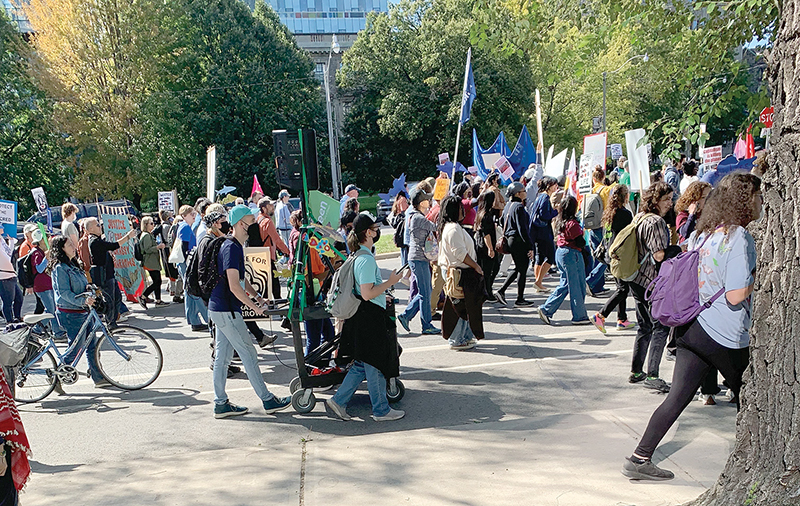
Rev. Lorna May joined thousands of people in downtown Toronto on Sept. 23 for the Grassy Narrows River Run, drawing attention to a mercury crisis that has affected the First Nation for generations.
May, a deacon at St. Luke’s Anglican Church in Creemore and community advocate, stated that her interest in the issue grew after attending webinars where she heard from those living with mercury poisoning.
"I heard firsthand reflections from some women elders and some women who have lived with mercury poisoning,” said May. “I just thought that something needed to be done.”
Through those webinars, May learned more about the issues the community faces and decided to attend the protest.
Approximately nine tonnes of mercury was released into the English- Wabigoon river system near Dryden during the 1960s and 1970s. Decades later, mercury levels in fish remain high enough that consumption advisories are still in effect. Community members and leaders travelled approximately 1,700 kilometres from Grassy Narrows to Toronto for the River Run to show their support and share their stories. Organizers called on the provincial and federal governments to provide fair compensation, prevent further pollution and industrial threats, and support the community in restoring its way of life. May said she knew the effects of mercury exposure could continue across generations, but hearing directly from people living with those effects made the issue feel more immediate and gut-wrenching. She was particularly struck by estimates that about 90 per cent of the Grassy Narrows population shows signs of mercury poisoning.
“Can you imagine growing up where everyone in your family is ill?” she said. “I can’t.”
When May arrived in Toronto, she said one of the first things she noticed was the energy of those taking part.
“There were lots of Indigenous people, but lots and lots of young people, young moms pulling their kids in wagons and just being there for the people,” she said.
The march travelled from Grange Park to Queen’s Park, and was accompanied by music and supporters walking alongside members of the Grassy Narrows community. One of the most powerful moments for May came at Queen’s Park, where she heard a grandmother speak about living with mercury poisoning and knowing that her grandchildren are also affected.
“You can hear it in their voices. All they want is some justice,” she said.
For May, attending the River Run also connected to the social justice and community work she has done in Creemore.
“We have a wonderful little community, and we have that because people are involved with each other for the good and the bad, the hard and the easy,” she said. “But also we need to look just a little bit broader. This is still in our province.”
May said the issue should also be a reminder to everyone that it is important to protect water that is close to home.
“We all need water to live. Water is essential,” she said. “It could be us in a different way.”
Since returning from the River Run, May said she has become more conscious of the products she uses at home, what goes down the drain and reports about pollution in the Great Lakes. She is also doing her part by planning to raise funds this month for the Barrie Native Friendship Centre through the Southern Georgian Bay Regional Ministry.
“I think people were encouraged by the numbers of people,” she said, “and just to keep the momentum going.”
For May, the message from the day was simple: “Every human has the right to dignified living conditions.
“We have to remember that water is sacred and it’s what keeps our planet sustainable,” she said.
Lorna May photo: Thousands of people attended the Grassy Narrows River Run in Toronto on Sept. 23 in support of Grassy Narrows First Nation.