by Christopher Dodd
I’ve never seen a ghost, but I know them well. For the last ten years I’ve been in their company. They’ve hovered constantly at the edge of my awareness, coming out of the shadows, interrupting my thoughts, and watching my every move. I have no one to blame except myself. After all, I conjured them.
When I first fell into the rabbit hole that would become my first book, Unseen Thing: The Mulmur Hills Poltergeist (September 2026), I knew it was going to be a helluva challenge. The events took place in 1930, nearly one hundred years ago. As an investigator, I had arrived on the scene a bit late. All of the key participants were long dead and forever out of reach.
Or so I thought.
To write about them, I had to learn how to become a historical detective, how to search for clues of their existence in the archives.
The dead, I learned, are never entirely absent. They leave traces of themselves. They are there in the grain of a torn sepia-coloured photograph, in words quoted in an old newspaper article. They surface in a half-remembered anecdote, a fading memory, a name recorded on a voters list, scribbled on a death certificate, or carved into the surface of a sunken cemetery marker nearly swallowed whole by the ground.
These scattered traces give shape to someone who was, at first, little more than an outline. A transparent figure. Over time, as the research continued, their forms sharpened. My writer’s mind stepped in, connecting fragments, imagining into the spaces between them. A creative reconstruction occurred — a conjuring, if you will — and somewhere in that process, the boundary between writer and subject became less distinct.
Something strange happened. Names in old newspaper clippings had faces again. For a few chapters they acquired animation, consciousness, emotion, and voice. Moments in time, recreated. Of course, enormous portions of their interior lives remained unrecoverable, yet somehow, on some level, they lived again on the page.
To write about the dead, I had to imagine myself into their world. Sometimes I watched them from a distance, studied their situations, tried to understand the pressures they faced; at other times, I stepped into them, imagining their thoughts and seeing the world, however imperfectly, through their eyes.
I lent them my attention, my empathy, my imagination, my language. Parts of them became parts of me, and inevitably, parts of me became part of them.
I think now about the mediums who operated at séances during the height of the Spiritualist movement, claiming to communicate with the dead and allowing the dead to speak through them. The comparison is imperfect, of course, perhaps too convenient a metaphor, but fitting given the subject matter of the story.
I didn’t realize it until I was near the end of Unseen Thing: I was writing about people who believed they were being haunted while gradually discovering that I too was being haunted by the dead, just in an entirely different way.
My work is done now. The book is finished and out there in the world. They, however, are still with me. I hope for their approval, but so far, they stand silent in their judgement. Part of me is waiting for these ghosts I made to fade away, to dissolve back into the shadows, but for now they refuse to leave. It seems they are not done with me, and perhaps that is because I am not yet done with them.
I wonder when they will go away.
I wonder if I really want them to.
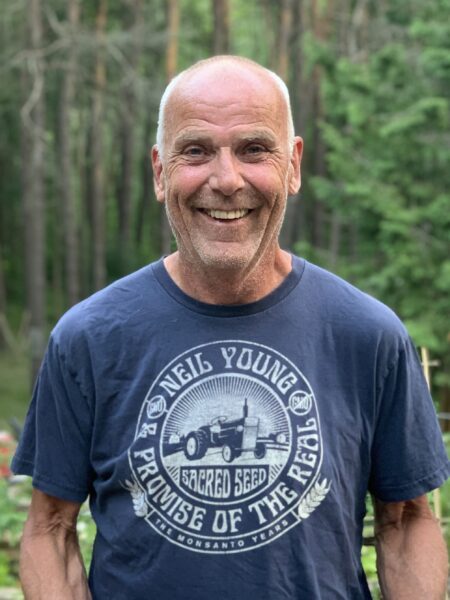
Christopher Dodd is the author of Unseen Thing: The Mulmur Hills Poltergeist, available at Curiosity House Books and wherever books are sold.