High speed internet, a game changer in Dunedin
John de Ruiter says having high speed internet in the area has brought Dunedin into the 21st Century.
He said village residents were desperate for high speed internet, even before the pandemic, and that’s why he reached out to the Rural Net team to see if it was possible to provide service there. He said having high speed internet is a game changer for people who are working from home, running home based businesses and students who are learning online. It also allows residents the ability to access streaming services, for much needed entertainment during a shutdown.
Until now, de Ruiter said his only internet options were dial-up or satellite internet. While some people could access cellular service, it was shoddy at best for those living right in the village.
“I could text kind of, but you couldn’t really place a phone call, and certainly since the pandemic hit, it wasn’t enough to do any streaming with,” said de Ruiter. “Now, it’s just a whole new world.”
He said they are over the moon to have high-speed internet, which is unlimited and at a lower cost, and everyone he knows has signed up for the service.
“I’ve had so many people say, it’s a game-changer. It has totally changed our lives. People these days, living in town don’t appreciate how much we rely on a solid connection,” said de Ruiter.
Rural Net founder Heiner Philipp said he got started as an internet provider because he needed internet for his Flesherton based engineering company.
“I couldn’t take it anymore,” said Philipp.
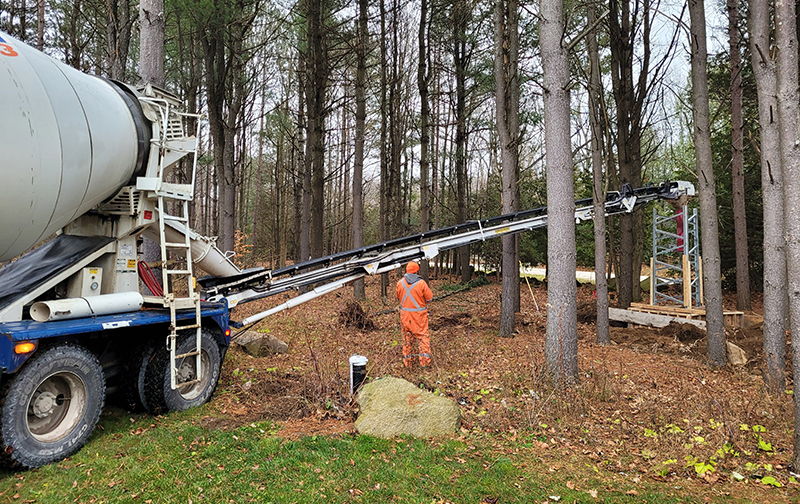
Out of shear frustration, in the middle of winter three years ago, he said he dug a hole in his front yard and put up a 96-foot tower.
“I didn’t even know where I was going to get internet from, but I knew I needed to reach out to somewhere and the higher I could go, the better my chances of getting something,” said Philipp.
He said he invested close to $400,000 to access an existing fibre network to provide fixed home wireless to his farm.
“Files were getting so large that I couldn’t deal with going to Tim Hortons anymore to use the wifi in the parking lot to send files or receive files, so I had to do something,” said Philipp.
“My fallback plan was that I was going to become the world’s smallest internet provider, with 50 customers.”
The idea was to make just enough to cover the fees so he set everything up to be automated so he could focus on his full-time engineering career.
“Once we had 50 people hooked up, there were 100 people asking for it and when we had 100 people hooked up, there were 200 people asking for it, so from there on in it pretty much grew on its own,” said Philipp.
He has become a renegade internet supplier, skirting the municipal process, providing service to those without options, happy to not lose money but not focussed on making money either.
He said he has heard from people desperate for good internet, people who have said they would lose their jobs if they couldn’t work from home during the pandemic, and others brought to tears at the frustration of having to work long days in their cars parked at Tim Hortons.
Rural Net has almost 2,000 customers now and they are growing at a rate of 100 per month this year, with the goal of scaling up to 200 per month next year. It has more than 40 towers, with three of those being on private property in Clearview, servicing about 200 residences.
Philipp takes issue with the fees and delays caused by following municipal protocol from erecting those towers so he says he is forced to “bulldoze” the municipalities.
Although telecommunication towers do not fall within the jurisdiction of municipalities, the federal government, which is the approval authority, recognizes municipal protocols as part of the approval process. The protocol is designed as a review process and a mechanism for public input. Clearview’s tower protocol requires a public meeting and site plan (but not site plan control) and an application fee of $5,000 plus a $3,000 deposit for each tower. Staff reported that the fees help cover the cost of staff time for coordinating the public process and managing feedback.
“They don’t enjoy my style because I just build it, hook up 50 people to it and then we apply to license it,” said Philipp. But by then, the residents are already hooked up and are happily streaming their favourite shows.
“I’m encouraged to do so by Industry Canada. I’m supposed to play nice with the municipalities but I’ve tried that in the past and what happens is you just end up going in a circle of fees, consultations, meetings, on and on and on and before you know it you’ve spent $25,000 and you haven’t accomplished anything other than paperwork. So I’ve given up on that process.”
He said the process may work for large companies that have more resources and stand to make huge profits but doesn’t work for a small company that isn’t really in it for the money.
“When we’re putting up $25,000 towers, all in, we can’t spend $25,000 on process,” said Philipp. “And we’re also providing unlimited internet for $40 per month and buying the fibre from Bell probably costs us $10. So I can’t double my costs on infrastructure by playing silly games with the municipalities.”
He said he has received exemptions from some municipalities once they see that the tower isn’t too tall and the internet is serving local residents.
When Clearview council discussed the issue Monday, members were unanimously against an exemption, instead voting to charge a one-time application fee of $5,000 instead of a separate fee for each of the three towers.
“My concern is that if we allow Rural Net to steamroll the municipality, and that’s their word not mine, we’re submitting to intimidation,” said Doug McKechnie, the ward councillor for Dunedin.
He agreed with the compromise but is concerned it will open the municipality up to future reluctance to pay fees.
“I want the public to know we want the service that Rural Net is providing but there are rules that have to be followed,” said Deputy Mayor Barry Burton. “If they’re going to play with the big boys they’ve got to get in there and play by the rules.”
Philipp said he does not accept the compromise and will not be paying any fees. He said he has not paid any application fees to date and doesn’t plan on doing so, that he would rather fight it in court to enforce that municipalities have no jurisdiction.
In their discussion council appeared sympathetic to small providers and recognized that the protocol should be reviewed.