Regulatory approval biggest hurdle to accessory homes
The solution to the affordable housing crisis may be waiting at our back doors, according to Thomas Vincent, CEO of ATTIMO Homes.
ATTIMO stands for attainable, tiny and modular, and Vincent believes tiny houses could be the key to providing plenty of affordable housing to fill a variety of needs. Through his long career as a real estate developer, Vincent pioneered concepts like corporate suites to provide housing for employees on short-term assignments or training programs. Six years ago, he was invited to a conference on housing in the Southern Georgian Bay region.
“I didn’t realize, prior to that, that local businesses were unable to fill about 2,500 positions due to the lack of affordable housing,” he says. “I suspect that since then, the need has doubled.”
In the wake of that conference, Vincent created a site plan for a tiny house village at Blue Mountain to house 300 employees. He was prepared to invest upwards of $40 million and in exchange, asked the municipality for a $1 per year lease on the land with a share of rental income going to the town. He says after about five meetings, the idea simply died on the vine.
Vincent also approached Clearview Township, with a proposal to create a tiny house village on the vacant lot adjacent to the Creemore library.
“We put together a site plan, but they couldn’t see the value in what we were creating,” he said.
Clearview Mayor Doug Measures has a different recollection.
“We were well on our way to making a decision about expanding the library at that time, so I knew the lot would not be suitable,” he said, adding that he did encourage Vincent to contact other landowners.
An ongoing review of Clearview’s Comprehensive Zoning Bylaw calls for up to two additional residential units (ARUs) within settlement areas such as Creemore, Stayner and New Lowell subject to availability of municipal services. Outside settlement areas, the proposed zoning bylaw would allow one ARU per lot.
The Comprehensive Zoning Bylaw is still under review and will be the subject of another public meeting on March 25.
Asked whether modular homes, including those built from shipping containers would be welcomed in Clearview, Measures said the township is open to modular construction, and in fact the recent Habitat for Humanity builds in Stayner were constructed offsite. Any buildings constructed from shipping containers would need to be modified to include “man doors” and proper ventilation and foundations in keeping with the Ontario Building Code.
Vincent says the biggest hurdle in creating accessory dwelling units or garden suites is typically regulatory approval.
“Each municipality has its own rules,” he explains.
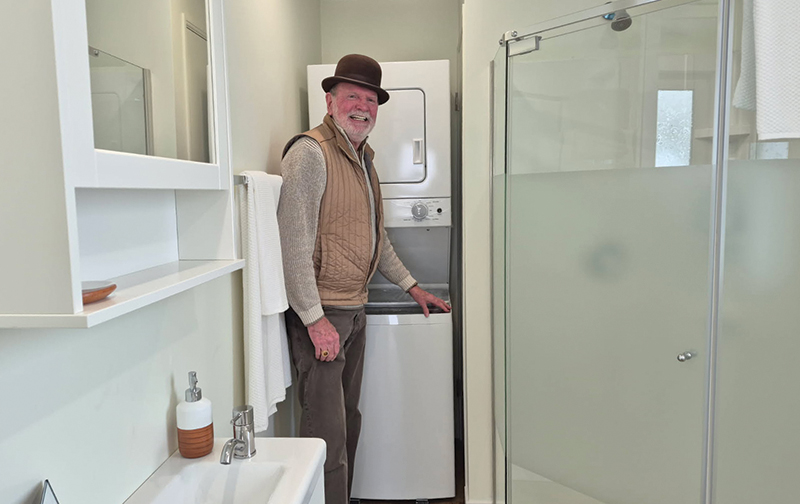
In Wasaga Beach, units can be up to 800 square feet. In Collingwood, lot coverage is limited to 40-45 per cent. His firm handles all planning and site prep work on behalf of clients. The display model, situated on High Street in Collingwood, is a one-bedroom 320-square foot unit built from a 40-by-eight foot shipping container, cut in half and reassembled in a 20-by-16 foot configuration. It includes a kitchen complete with dishwasher, three-piece bath and ensuite laundry. That unit sells for about $150,000.
An 850-square-foot, two-bedroom unit with carport and deck is priced at $350,000.
Once approvals are secured and site prep completed, the unit is manufactured offsite and delivered, and assembled in a matter of hours. It typically takes three to four days to install services then the home is ready for occupancy, and if the homeowner’s needs change, it can be moved to a new site.
When you mention attainable or affordable housing, Vincent says, people assume you are talking about social housing, which for many has negative connotations.
“But,” he says, “it’s about workforce housing and options for multi-generational living. A typical tiny home village includes a range of housing types with both rental and ownership opportunities. Education is essential, to get people and companies to understand the value in creating attainable housing.”
Data from the Ontario Association of Municipalities (AMO) estimates that 85,000 Ontarians were homeless in 2025, and AMO says an investment of $11 billion from all levels of government is needed over the next 10 years to boost the supply of supportive, transitional and community housing and address the problem of chronic homelessness in Ontario.
Vincent was the driving force behind the creation of Balmoral Village Collingwood, a 25-acre “age in place” adult lifestyle community. The site includes 96 bungalows and townhouses, a 50-unit rental building and recreational facilities, plus a 130-unit retirement residence that is operated by Chartwell Retirement Homes. He says the inspiration was in watching the changing needs of his own parents. His firm is also heavily involved in the Homes for Heroes program which is working to provide housing for an estimated 10,000 displaced veterans.
His company has relationships with 15 different modular home builders, and says the biggest problem is finding land.
Vincent says he is in the business to make a difference saying, “I don’t care who does it, let’s just get it done.”
Bonnie MacPherson photo: ATTIMO Homes CEO Thomas Vincent showcases a 320 square foot one-bedroom tiny home display model in Collingwood, built from a 40-by-eight foot shipping container.