Hort Society grows and greens Creemore over 100 years
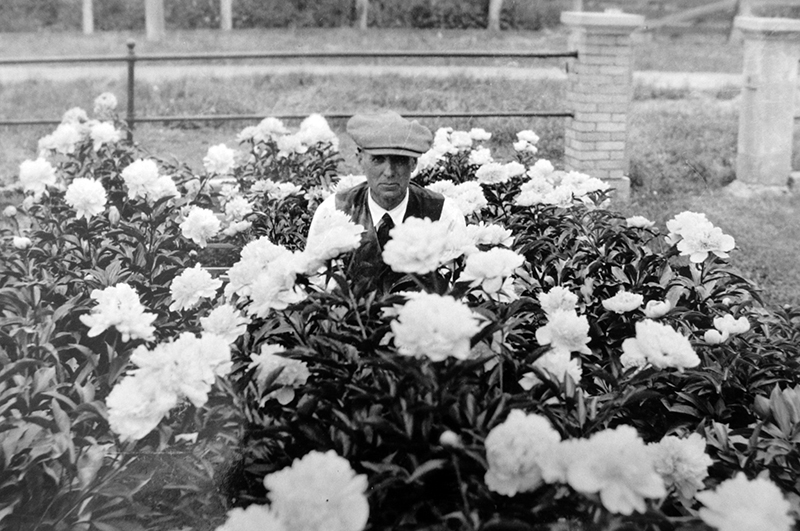
It has been said that the Hiseys made Creemore. The legacy of the village’s early entrepreneurs can still be seen throughout Creemore, including many of the buildings. It was Jacob Hisey, who in 1921 founded the Creemore Horticultural Society with the aim of beautifying the community.
This year, the Creemore Horticultural Society is celebrating the 100th anniversary of the organization.
“The Hort Society has always been more than a gardening group,” said Creemore Horticultural Society president Judi Parker. “We’ve been a community booster. That was always the idea, was to better Creemore by beautifying it through gardening.”
Throughout the years the interest in the society has ebbed and flowed but in active times, the group has organized events including the annual flower shows with attendance of about 500 and an impressive prize list, garden tours, and sales, all with the goal of beautifying the community, educating, and engaging. In recent years there is always a line-up at the annual plant sale.
Throughout the years, the Society has planted trees, purchased benches for the village, created flower boxes for the main street, organized programs for youth, and has created and cared for a number of flower beds. Many of the names of past officers and winners are still prevalent in Creemore and area today.
Community members may remember being crowned Sunflower King or Queen, or attending a Lilac Tea, or Daisy Day.
“The society had many very prosperous years holding large displays of members’ plants and flowers in the arena, hoping to win a ribbon or a trophy,” states A Glimpse of Creemore’s Past. “Many sad looking corners around the village have been brightened by the addition of flowers and trees planted by the Creemore Horticultural Society.”
The first meeting of the Society was held in Mr. Hisey’s office, at 176 Mill St., on April 11, 1921. Having received a government grant in the amount of $75, the society set out its rules and elected Hisey president.
The first order of business was to host a flower show. A small admission was to be charged to help purchase the options for the fall lists. Proceeds from the show amounted to $22.25.
The following year, membership was at 142 and a two-day flower show was to be held and on a date that would enable them to send a good contribution to the Toronto Exhibition.
In those early years, Hisey donated a silver cup to the competition in a certain class of flowers, which one would have to win for three years in order to win the cup.
In its third year, membership grew to 171 and Hisey’s enthusiasm inspired people to look after their flower gardens and to hunt up places within the village that could be turned into “beauty spots.”
One of the first spots to be beautified by the Horticultural Society was the CNR Park, next to the TD Bank, donated to the society by CNR in 1925, an area that is still being looked after by Society volunteers. Up until 1939 CNR provided plants for the flowerbeds.
Membership to the Creemore Horticultural Society was originally set at $1 and it wasn’t until 1983 that the executive committee voted to raise the fee to $2. In honour of the 100th anniversary, memberships are currently being sold at that historic low price of $1.
Dorothy Shropshire joined in 1992, after retiring from teaching.
“That’s when I really started my own gardening in earnest, so I learned a lot,” she said.
While attending meetings, the social time gave her the opportunity to meet new people in town, with whom there were common interests.
Shropshire served as president from 1996-2000, and is a past district director. She and Kathy Meeser take care of Grandmother’s Garden at Creemore Log Cabin, one of the Society’s beautification projects.
Marie Kidd is a long-time member of the Society, having attended events with her mother in the old arena before becoming a member in the late 1950s. Kidd served as president from 1992-1995 and was an avid competitor in the annual flower shows, taking many prizes, ribbons and trophies.
At 94, she is still gardening, and said she has really enjoyed her time with the horticultural societies in Creemore and Brentwood. Participating in the floral design contests, walking in the Santa Claus parades and meeting people, are among the highlights for her.
“I congratulate them on the anniversary,” said Kidd, “I wish them luck and many more years.”
The Hiseys
The contributions of the Hiseys cannot be understated. Jacob and his brother Sam, whose father established the Meat Market, got into buying and selling livestock, focussing on hogs. They would ship livestock to Collingwood by railway, averaging 30 double decker car loads per week, earning the train the nickname The Hog Special.
In 1900 they built a modern elevator on the rail line west of the main street and became large buyers and shippers of grain. (The elevator burned to the ground in 1970). A modern office was built on the main street in 1901 and contained a substantial vault which served as the village’s only bank. Enormous amounts of money were held there in order to pay the farmers, as well as large amounts of money belonging to local residents and farmers held for short terms.
The brothers were also instrumental in establishing a water system in 1905, making Creemore one of the first communities in Ontario to have water piped into every home.
– With files from A Glimpse of Creemore’s Past, Helen Blackburn and the Creemore Horticultural Society archives.
Image: Jacob Hisey with his peonies at his house in Creemore. Both Sam and Jake Hisey built fine homes on the village’s main street. One was the light brick house on the corner of Mill and Johnston Sts., often called the Rinn house. Another was directly across the street.