More than gross: invasive worms, disease threaten ecoculture
After a couple of gardening seasons battling an infestation of spongy moths), Ontario gardeners have a new set of threats to deal with.
Asian jumping worms
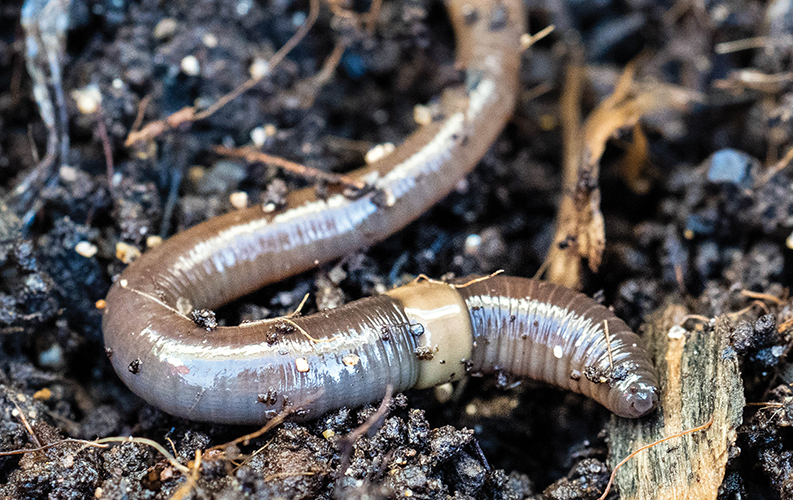
Cathy Krar of the Simcoe County Master Gardeners says Invasive Asian Jumping Worms are headed our way. The worms have been spotted in the Windsor, Hamilton and Niagara regions. Unlike regular earthworms which transport nutrients down into the soil, Asian jumping worms stick close to the surface and feed on leaf litter and small roots. Their castings resemble coffee grounds and can change the soil composition and lead to increased soil erosion. Native plants struggle, and the root systems of trees are exposed over time. Sugar maples are especially vulnerable. There is no effective means of eradicating the worms on a larger scale. The best defence is to prevent spreading them in the first place. Clean footwear thoroughly after hiking or visiting other gardens and transplant only bare root stock or plants from a reputable local nursery.
Asian jumping worms are characterized by a whitish band around the body, close to the head. When disturbed, they thrash about wildly. If you find them in your garden, Krar says get rid of them and never use them for bait. Place them in a clear plastic bag and leave them in the sun for at least 10 minutes or drown them in isopropyl alcohol.
Hammerhead worms
As if Asian jumping worms weren’t bad enough, be on the lookout for Hammerhead Worms. They look a bit like leeches with flat bodies and fan shaped heads. They are slow moving and secrete a neurotoxin which can cause human fingers to tingle or break out in a rash. They attack useful earthworms, snails and slugs.
Dr. John Warren Reynolds, a worm expert at the Oligochaetology Laboratory in Kitchener, says they typically vary in size from about one inch (2.5 cm) to 15 inches (38 cm). “If you chop them up, each section can grow into a new worm,” says Reynolds.
The worms have been reported in Hamilton, Newmarket and Woolwich. As with jumping worms, the best approach is to prevent the spread. If you do find them in your garden, seal them in a clear plastic bag and leave them in the sun.
Hosta Virus X
At a recent meeting of the Creemore Horticultural Society, member Barbara Mann issued an alert about Hosta Virus X, which can affect any of the 10,000 plus varieties of hosta.
Mann has more than 50 varieties in her collection and last summer discovered an infected plant. The virus can lie dormant in the soil for years then attack plants causing tissue collapse or discolouration along veins. If you do find an infected plant, Mann says it must be destroyed.
“Do not put it in your compost and don’t plant another hosta in that location for several years,” she says.
The virus can be transmitted through sap so all tools should be cleaned thoroughly between plants. Mann recommended several online resources including ontariohostasociety.com, hostalibrary.org and a Facebook Group devoted to Hosta diseases and pests.
Oak Wilt
The latest threat to the tree canopy is Oak Wilt. Horticulturalist Elizabeth Hitchens of Hill ‘n Dale Landscaping says the fungal disease which affects moisture uptake in the trees is coming to Ontario. Isolated cases have been found in Elmvale and Springwater. White and red oak are less susceptible and while there is no cure, Hitchens says, the best defence is to avoid pruning between April and November. If you must prune, go old school and use pruning paint to seal the cuts. Hitchens says people should continue to plant oaks as they harbour up to 400 species of insects and moths which are very important to the environment and provide food for songbirds. If you do have an infected tree, it’s important to cut any roots that intertwine with nearby trees. Hitchens suggests planting oaks far apart, sort of social distancing for trees.
Photo: Helen Phillips/Erin Cameron (Canadian Council on Invasive Species)