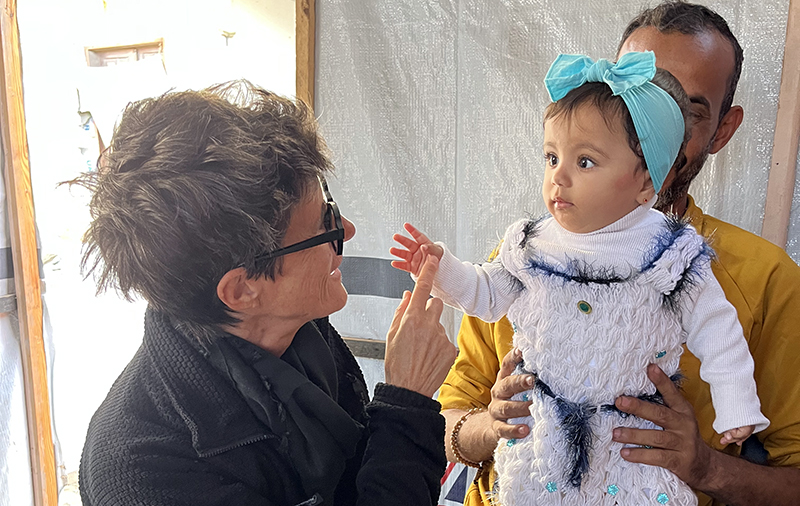
Talk aims to raise funds for families in Gaza
A doctor who has been on the ground in Gaza doing humanitarian medical work will be sharing her experiences with an audience in Creemore. Dr. Melinda Brecknell will be in town over the holidays at the invitation of MK Lynde and Tammy Yiu Coyne, who have been fundraising for families impacted by the Gaza war.
Brecknell said the situation in Gaza is dire. She has been there four times since October 2023, most recently with an emergency medical team brought in by the Canadian-Palestinian organization Glia, under the umbrella of the World Health Organization.
“I could not believe what I was seeing. It was post-apocalyptic,” said Brecknell. “It was utter destruction everywhere.”
With restrictions on journalists, Brecknell said she now sees her role as a witness to what is going on in Gaza, to try and humanize the numbers and talk about what it’s like for the Palestinians she has worked with.
She said emergency medical team doctors like herself are vetted by the Israeli government before being admitted into Gaza and those who are too vocal in the media and on social media may be denied, sometimes the night before they are to deploy, when they are already in Jordan.
“It’s very difficult to analyze completely the reasoning,” said Brecknell. “But one is certainly media, and the other that we’re findingmore and more, is that if you are deemed to be particularly useful, as in medically useful – those would be surgeons, particularly plastic surgeons, orthopaedic surgeons, vascular surgeons to deal with amputations, nephrologists – those kinds of people are being denied. I haven’t been denied, and I think my hypothesis for that is, as an emergency doctor, there is very little we can do there because we don’t have the resources. I can diagnose someone as having a heart attack, but I have no medication to give them. I can try and stop someone bleeding when they’ve lost a limb, but I’m not a surgeon, so I really found, this last time, that there was so often very little I could do to help.”
She said she has come to realize that she is more useful speaking out than going back.
“There’s a very fine balance that I think all of us have, every single person who’s been in there – humanitarians and UN workers – is this topic of complicity, because if we don’t speak out, we’re complicit to what we’ve seen,” said Brecknell. “I mean, 70 per cent of essential medications are lacking. We didn’t have gauze, we didn’t have soap to wash our hands, and it hasn’t improved, even since the cease-fire, they’re still not allowing the medical supplies in. So, I am better placed to speak out.”
Brecknell says during her latest mission in Gaza she witnessed utter destruction, the Gaza Strip destroyed, and Rafah – once a thriving city – reduced to “pure dust.” And now famine.
“The Palestinians that I knew were, on average, between 15 and 20 kilos lighter, and I was seeing starving human beings like I had never seen starvation before. And so that was very, very striking this last time,” said Brecknell.
She said the humanitarian zone has been shrinking and the yellow zone, occupied by Israeli forces, is currently just over 50 per cent of the Gaza Strip.
“If anyone approached that yellow zone, they would be shot,” said Brecknell. “So even with cease- fire being called, we were getting all these people who had breached the yellow zone or were close to it, and these were people who were going back to their homes to see if their home existed, to see if any of their belongings were there, anything that they could salvage, or look for their loved ones under the rubble. They would go into that zone and either get hit by a missile or by a drone… On my last day, there was a seven-year-old child who had been sitting in his tent, and he came in with a bullet through his buttocks, and he was just sitting in his tent.”
Local medical professionals have been working for two years without pay and without a break, some are without shelter.
“One-in-10 people have lost a family member. One-in-three people has someone in their family who has been critically injured, and they are working. Having been displaced, they’ve moved from hospital to hospital,” said Brecknell. “Hundreds of their colleagues have been abducted from hospitals and have been taken into detention in Israel. I’ve met some of them who’ve been released [and heard] the stories of what’s happened to them, the stories of torture. I’ve seen the injuries, and these are doctors and nurses, medics, cleaners and X-ray staff who come in and who meet us with such gratitude. And every morning they come and they say, thank you, thank you for being here. And from my perspective, even though medically I didn’t feel that I could do a lot, particularly this last time, the gratitude, the patients, the children that were so happy that we were there to try and help, was really the driving force, because these people are exhausted. The cease-fire, yes, that gave them some hope but they have no future. They have no homes. There’s no sewage, there’s noelectricity, there’s no water.”
The United Nations has said it would like to see 600-1,000 trucks of aid per day, for two million people – and although the exact amount is unknown, the number of trucks allowed in could be around 200.
Brecknell said the food she has seen distributed is not nutritious, and very expensive.
“Their future is so incredibly bleak that, for them, even if the bombs aren’t falling every day and every night, they’ve got to think about their future, their families, and what they’re going to do,” said Brecknell. “And unfortunately, even though there’s a cease-fire, there’s on average two kids a day who are being killed. There are still bombings constantly. Two days after the cease-fire, I was involved in mass casualty events where over 100 people were killed in one night.”
Brecknell said there is nowhere for the people to flee. They are trapped in a highly militarized zone. People there have been displaced many times.
“It’s like a boiling pot,” she said. “So they flee from the north to the south… each time they move, if they can afford fuel, because fuel is in desperate shortage, or if they have a motor vehicle, or they use donkeys, and unfortunately, there’s not enough food for the donkeys, and the donkeys are their main form of transport, and the donkeys are exhausted. They’re malnourished, and it costs them an awful lot of money. So now what’s happening is a lot of people say, we’re just not moving. They’re just too exhausted to move, so they’re just staying put saying, ‘If I die tonight or die tomorrow, my life will be easier than if I actually moved again.’ And we heard that regularly.”
Proceeds from the fundraiser will go to specific families for the basic necessities needed to survive – food, water, clothing, shelter, medicine and medical supplies for injuries and illnesses related to sanitation issues and malnutrition.
Yiu Coyne and Lynde were contacted by families via Instagram. Seeing sympathetic content, the Palestinian families reached out for help.
One family, living in the razed city of Khan Yunis in the southern Gaza Strip, had a baby and later lost another baby due to malnutrition.
Yiu Coyne said after vetting the families she set up a Go Fund Me account.
“When I started this Go Fund Me, as just some derpy person in the middle of nowhere Simcoe County, I wouldn’t have thought that, together, we could have raised up until now, $45,000 or something,” said Yiu Coyne.
Together, she and Lynde are collecting funds for seven families, some of whose stories will be shared at the Dec. 28 event. They are part of a network of westerners coordinating aid.
Lynde said there is a push by the community to get about five families into new tents.
“We have one family whose few belongings they accumulated were destroyed by an airstrike last winter.
So all these folks are continuously, sort of starting from scratch, but with no money,” said Yiu Coyne. “So it seems like the easiest thing to do right now is to send the money so they can at least deal with buying food and clothing and shelter for the immediate future.”
For the event, there is a plan to bring in Hanya Al Jamal by video. The senior project coordinator for Action For Humanity and the 2025 Young Humanitarian Hero of the Year Award winner will be interviewed live by journalist Avery Haines. Al Jamal is currently studying in the UK, having received a scholarship and a way out of Gaza.
The event will be held at Station on the Green in Creemore from 2 p.m. to 4 p.m. on Dec. 28. Tickets cost $25 on www.eventbrite.ca. Search A Doctor’s Work: Reflections from Gaza – Talk and Fundraiser. The presentation will include a Q&A.
Contributed photo: Dr. Melinda Brecknell during a medical mission in Gaza.