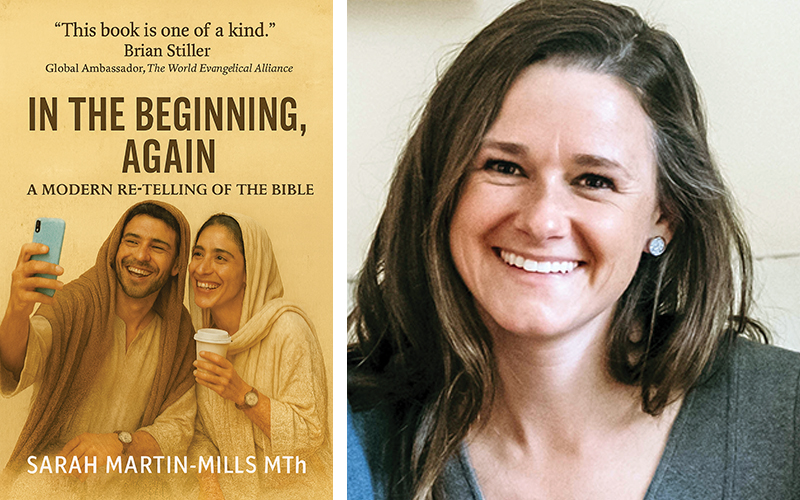
Author aims to make Bible stories relatable
What if the Nativity story was set in a house, during a family gathering? The visitors being night shift workers and businesspeople bearing gifts of diapers and food, the baby Jesus sleeping in a wooden drawer.
This is how the story, named Room in the House, is reimagined by Sarah Martin-Mills in her new book In the Beginning Again: A Modern Retelling of the Bible. The book includes a retelling of 34 stories, and endnotes explaining the story behind the stories.
With a degree in history and a masters in theology, combined with a lifetime of Bible learning, Martin-Mills has set out to make Bible stories more relatable. She said she did not set out to re-write the Bible, just to modernize it. She said it’s common for scholars to interpret the Bible in different ways, and taking some of the widely accepted themes and interpretations, she has made its teachings more accessible.
“That’s what Jesus did,” said Martin- Mills, referring to the Book of Isaiah. “A lot of the New Testament is just Isaiah rejigged for his audience. That was obviously important to him, to make something applicable to his audience so that everyone got it.”
She set out to strip away years of cultural interpretation to get to the core messages.
“It’s all an educated guess but trying to peel back the layers of humanity’s baggage that they’ve piled on to the Bible, which has sometimes been for the better and sometimes for the worse,” said Martin-Mills.
She had been working in a youth detention centre and found that the youth, during Bible study, weren’t able to connect to the Bible stories so she would reframe them for the modern era.
“You’d see the light bulb go off,” said Martin-Mills. “And then they’d become interested.”
She said the youth could see that Jesus was a radical figure and that they’d get excited.
She wondered if she could do the same for the general population, recognizing people don’t have time and the brain space to complete their daily tasks, let alone engage with the Bible.
She noticed that pastors were focussing on the history of the stories instead of making them relevant to modern times.
Martin-Mills said she left the church briefly as a teen and young adult, partly because she was having trouble placing God in modern times, and figuring out how he relates to the trials of a teenage girl.
“That’s part of why I left the faith,” she said. “I had so may questions and nobody was willing to tackle those questions with me.”
She asked, why Jesus wasn’t performing miracles now, like in the Bible, and where is God, why isn’t he answering prayers and why she couldn’t feel his presence?
She said she’s now much more comfortable with those questions.
“Like everyone who has these questions if they’ve dived into any faith, and I’m now much more willing to embrace those questions,” said Martin- Mills. “You’re never going to get all your questions answered.”
She said the idea for the book came from her experience working with youth but it took a decade before she finally sat down to write the book, after committing to a self-publishing deadline.
The book is available on Amazon. The book is available for $14.99, or the Kindle edition for $8.24.
Ten per cent of proceeds from the book go to Mennonite Central Committee, a global, non-profit organization that strives to share God’s love and compassion for all through relief, development and peace building.
Room in the House, an excerpt
The baby came that night.
The power went out just as the contractions grew serious. Half the city blacked out. Salma lit candles and old kerosene lamps. Someone boiled water on the barbecue. The heat from the bodies packed in the room, the flickering candle wax, the steady breathing of the dog and the twitching ears of the cat, it all made the air thick. But the women were calm. Salma held my hand. Joseph whispered prayers.
I pushed. Screamed. Sweated. And then, a cry.
A boy.
We wrapped him in one of Joseph’s old undershirts and placed him in the bottom drawer of a broken dresser that someone had lined with soft cloth. The drawer fit snug between my mattress and the heater. The baby slept like the world had always been ready for him.
We hadn’t even named him yet. But already, he belonged.
The first visitors came an hour later.
A group of night-shift workers from the warehouse down the street. They’d heard about a baby being born during the blackout—the nurse next door had told them. They knocked, awkward and hesitant.
“Can we see the baby?”
Salma let them in.
They came with grocery bags: instant noodles, baby wipes, Gatorade. One of them, a man with grease-stained hands, saw the baby in the drawer and choked up.
“My daughter slept in one just like that,” he said.
They didn’t stay long. But they left changed. I could see it in their faces.
They came scared. Afraid they wouldn’t be let in. That they’d be told to leave. But the baby was wrapped just like theirs had been, laid in something they understood. Their sign wasn’t a miracle. It was familiarity. The message was clear: You are welcome here.
It struck me, the ones at the bottom of the social scale were the first to arrive. Not because we were desperate. But because we were open. There was no gatekeeper, no priest, no threshold of worthiness. Just people, and a child.
A few days later, the fancy ones came. Foreigners. Not missionaries or tourists—businesspeople, I think. They were dressed too nicely to be local. One had a driver.
“We heard about the child,” one said. “We wanted to pay our respects.”
They brought gifts: diapers, gold jewelry, and a check I didn’t dare to look at.
They stood in our living room like they were on holy ground. And somehow, they were.
One knelt beside the drawer and whispered, “We expected a temple. Not this.”
Joseph said, “So did we.”
They left quietly. No photos. No posts. It felt like worship.
I learned later they were from the East. Arabia, maybe. Isaiah once said gold and frankincense would be brought, that sons and daughters would come from afar. Maybe he thought they’d come to Jerusalem. But they came to a child. Not a city. Not a throne. Not even a synagogue. A child.
And now, a week later, the house is still full. My body is sore. My baby sleeps in the drawer. People still come.
No one calls him Messiah. No one says prophecy. No one talks of kings or stars.
But they bring food. They hold him. They bless him.
And I think: maybe the angel didn’t mean power when he said this child would save.
Maybe he meant presence.
Maybe he meant: The poor will know they are not forgotten. The outcast will know they belong. The broken will know they are loved.
Maybe salvation begins in the middle of the noise, in a room with no space, in the warmth of the social outcast and the hands of women.
Maybe it begins in a house like this.
With a baby like mine.