NVCA to join new Lake Huron Regional CA
Deputy Mayor Paul Van Staveren said he is optimistic about the consolidation of conservation authorities (CAs) for the good of the province as a whole.
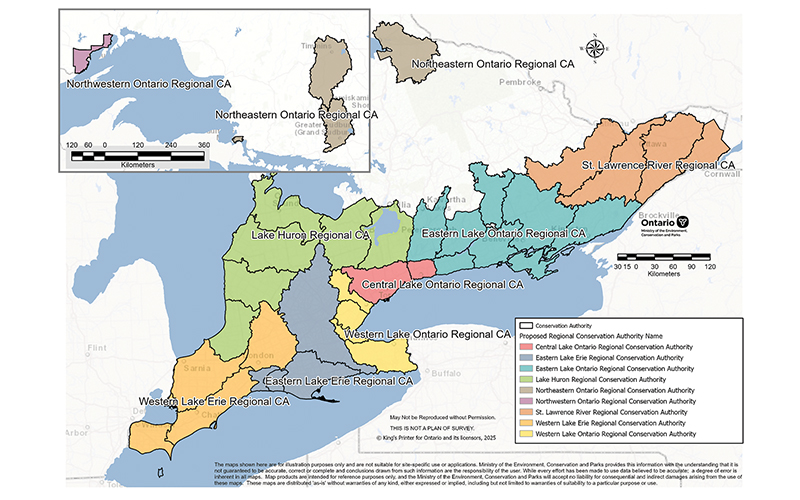
“We can’t be selfish and say it isn’t better for us but it will be better for a lot of other communities,” said Van Staveren, who is Clearview Township’s representative on the Nottawasaga Valley Conservation Authority (NVCA), which will be amalgamated into a new Lake Huron Regional Conservation Authority next year, after the provincial government introduces legislative amendments to the Conservation Authorities Act (CAA). The Lake Huron Regional Conservation Authority would integrate six CAs – Nottawasaga Valley, Saugeen Valley, Maitland Valley, Lake Simcoe Region, Grey Sauble and Ausable Bayfield.
Should the amendments pass, the province intends to amalgamate 36 conservation authorities into nine.
The government said, “As a result of our plan for consolidation, the nine regional CAs would deliver more consistent and efficient operations. This improved efficiency and reduced administrative duplication would allow resources to be re-directed to frontline conservation efforts and improved customer service for municipalities and permit applicants, while ensuring decisions continue to be based on sound science and supported by local advice.”
Clearview is fortunate to be governed by only one conservation authority, said Van Staveren, while other municipalities are located in the jurisdiction of up to five different conservation authorities. He said the government is tired of getting complaints about it.
“It’s hard for a lot of municipalities to deal with it,” said Van Staveren. “We are very lucky in Clearview and this area, with the NVCA, we’ve really cleaned it up, it’s really running well. We’ve got a lot of our problems solved but other municipalities have not been able to do that.”
In recent years the NVCA has modernized, streamlined, and reduced average permitting times down to 17 days.
“We did know there was going to be change. You can’t fight it, you have to go along with it,” said Van Staveren, adding that the CAs are largely funded by municipalities but are governed by provincial legislation. He said there is a lot of community investment in the NVCA.
“We don’t want to lose that money, we want that money to stay in our own area and they’ve agreed to that,” said Van Staveren, adding that there are still a lot of unknowns about how the plans will be rolled out.
Conservation authorities were created to protect communities from natural hazards within their local watersheds. They are responsible for issuing permits for building and development of housing, and sewage systems in area affected by risks, such as floodplains, shorelines, rivers, and wetlands. They are also responsible for drinking water source protection, flood forecasting, and provide nature related programming.
In a March 10 media backgrounder the province laid out its plans for Improving Ontario’s Conservation Authority System.
“The Ontario government is taking action to protect Ontario’s economy, workers, and communities by making the province the best place in the G7 to invest, create jobs and do business. To achieve this, the government is making investments to build local infrastructure and taking action to bring more consistency and transparency to the cost and timelines of building homes,” states the backgrounder. “CAs are independent, local public sector organizations with significant variation in capacity, governance, transparency, and reliance on municipal funding. Over time, this has created a fragmented system with inconsistent standards and timelines.”
Initially, seven conservation authorities were proposed but based on public feedback, the mapping was adjusted. When the maps were made public in late 2025, Lakehead Region Conservation Authority on Lake Superior was lumped in with Lake Huron, including the NVCA.
The government is now proposing to keep Lakehead Region Conservation Authority intact, rebranded as the
Northwestern Regional Conservation Authority – for a total of eight new entities.
The NVCA board of directors, which is made up of elected officials representing each of the 18 member municipalities in the Nottawasaga Valley watershed, took the position that a consolidation of this scale was not necessary but if it were carried out, it would be better to not link Lake Huron with Lake Superior.
NVCA chair Jonathan Scott, who is a council member in Bradford West Gwillimbury, said the board sees the decision to keep them separate as a positive step.
“My attitude, as board chair is that we have eight or nine months left in this term (of council), we need to be focussed on dealing with the hand the government has dealt us, as collaboratively and effectively as possible,” he said.
Scott said there are a lot of unknowns and a lot of questions yet to be answered. “It’s going to be a big job to say the least,” he said.
Under the new structure, representation will be shifted to the upper tier municipalities, meaning that lower tier municipalities like Clearview Township would no longer be participating. Where it isn’t already, representation would be from the county, region or single-tier government, therefore 57 upper-tier municipalities would be included in the nine CAs, with some overlap remaining – 16 being governed by two CAs, four being governed by three CAs, and one being governed by four CAs.
Scott said he imagines the political structure to be the easiest to manage.
“Even that is going to need to have some nuance because that local small- town rural voice is really important,” he said. “Within the NVCA, we have some really tiny rural townships that bring a unique perspective, given their budget constraints, but also given our agricultural sector, both in bigger towns and smaller townships, that the rural agricultural small-town voice isn’t lost in all of this with everything levelling up to the county level.”
“For better or for worse,” said Scott, “the province has opened up a can of worms. Now, anything in municipal politics is solvable, this is just going to take time and effort, and money, and in a sense is a bit of a distraction from the core business of reviewing planning and permitting files to facilitate residential, commercial and industrial development, protecting the environment, and running educational programs, etc…”
Scott said there may not be a lot of job losses at conservation authorities across the province if regional offices are maintained to serve the existing population and meet development pressures.
“I would assume the easiest way to continue doing that as close to business as usual is to treat this new mega regional authority as the umbrella corporation over and above the six regional corporations,” he said.
In November, the province created the Ontario Provincial Conservation Agency (OPCA) to lead the consolidation.
The plan is to establish transition committees for each of the new regional CAs with members to include the chief administrative officer (CAO)/ general manager and a municipally- elected board member from each of the current CAs and any other members as appointed by OPCA. The committees will develop transition plans to prepare for the consolidation, subject to OPCA’s review.
The project executives appointed by OPCA would also serve as inaugural CAO of the regional CA for up to 24 months upon consolidation to ensure stability and continuity in leadership.
The Ministry of the Environment Conservation and Parks plans to propose amendments to the CAA that would require each regional CA to establish one or more watershed councils to ensure local priorities are identified and considered by the regional CA and create regulation-making authority for the Minister to outline the number, composition, functions, powers, duties, activities and procedures of watershed councils.
On March 10, the minister announced a new annual $3 million fund to be administered by OPCA to support the transition and CA system transformation. This funding will ensure OPCA has the tools and resources to support CAs and coordinate a successful transition over the next year with minimal disruptions to CAs’ governance, programs and services.
Image: The province plans to introduce legislation that would result in the consolidation of 36 conservation authorities into nine. The Lake Huron Regional Conservation Authority would integrate six CAs – Nottawasaga Valley, Saugeen Valley, Maitland Valley, Lake Simcoe Region, Grey Sauble and Ausable Bayfield.