Home & Garden: Bathed in blue
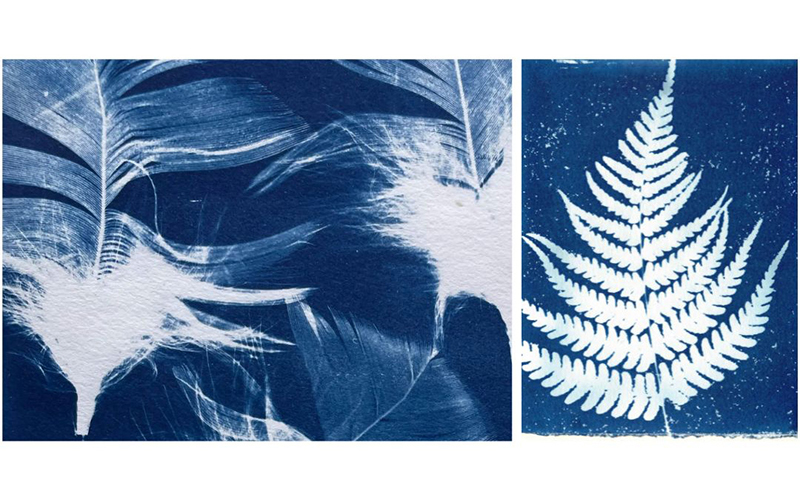
There is something magical about immersing a piece of paper into an iron salt bath and watching an image emerge, according to Cyanotype artist Patricia Vega. At her studio, nestled near the bottom of the Mansfield Ski Club, Vega creates prints on paper, wood, glass and fabric, many featuring botanical themes. She describes cyanotype as a process where art and science meet, using the power of sunlight.
Originally from Argentina, Vega studied fine art and print making. She immigrated to Canada 36 years ago and spent time in Brampton, Mississauga, and Palgrave before falling in love with the Mansfield area. She opened her Mansfield studio after the pandemic, and now conducts workshops for aspiring artists.
Cyanotype is a historical photographic printing process that produces distinctive blue images using iron salts and ultraviolet light. The process was invented in the 1840s by English scientist Sir John Herschel who discovered that certain iron salts darken when exposed to ultraviolet light. The technique was popularized by the work of Anna Atkins who used it to produce the first photographically illustrated book, Photographs of British Algae, documenting botanical specimens. It is the same technique traditionally used by architects and engineers to create blueprints.
Vega says a big part of the appeal of cyanotype is that it requires little in the way of equipment, and the chemicals involved are non-toxic and easily available.
“It works well on natural surfaces that absorb liquid,” said Vega. “The first step is to prep the surface with a solution of Potassium Ferricyanide and Ammonium Citrate to make it photo sensitive. At this stage, the background becomes grey- green. Once it dries, away from light, subject matter, often dried plants can be arranged on the surface.”
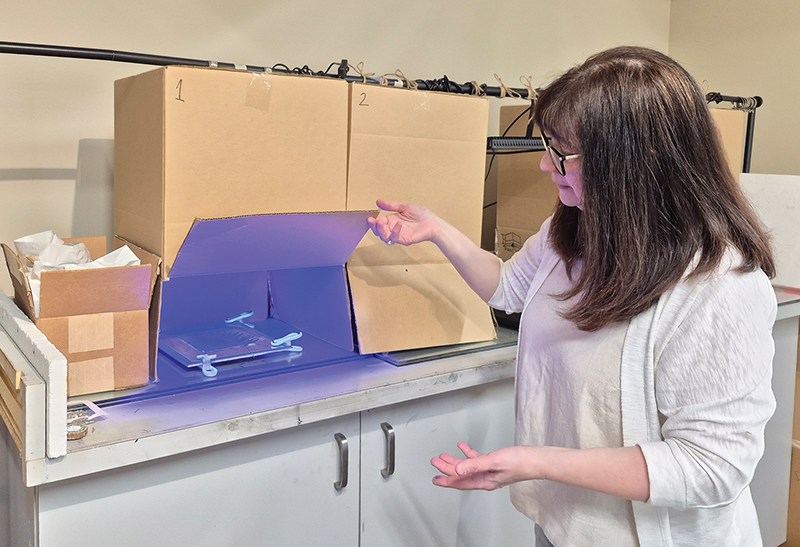
Vega uses a system of glass plates to press found objects onto the background. “You are working with negatives here,” she said. “The items that you place on the background will remain white or shades of grey as they develop depending how opaque they are and how tightly they are pressed to the background material. The background will ultimately be blue. You are not working with colour, you are working with shape.”
Occasionally, she enhances images with selective application of watercolours.
Vega likes to layer bits of plant material, lace, fabric and occasionally stencils. Once she is satisfied with the composition, the piece is exposed to UV light, either inside the studio or outside in the sun. At this stage, the background becomes more grey than green. Then it is immersed in the iron salt solution which produces the distinctive Persian blue pigment. Once the image is fully developed, chemicals are rinsed off and the piece is left to dry.
Vega conducts workshops for groups of up to five participants at her Mansfield studio. The next workshop, Saturday,
May 30 from noon to 4 p.m. will teach the basics of print making on paper. All materials are supplied, although she does recommend that you come prepared with old clothes, an apron and a hat. In the event it’s a clear sunny day, pieces will be taken outside for exposure to sunlight. Otherwise, the magic will all happen indoors. Each participant will leave with several pieces ready to frame or mount on greeting cards. Participants will learn the basics of the cyanotype process and some basics of design and composition. Vega encourages people to bring flat objects such dried or fresh flowers and leaves, feathers, lace, and other interesting flat textures to experiment with.
On June 13, the focus will shift to print making on textiles. Vega does recommend taking the paper workshop first. Each workshop is $110 per person. Should those dates not be convenient, she can arrange special group sessions. For registration and workshop details, go to www.patriciavega.ca/workshops.