Home & Garden: Climate change results in new plant hardiness zones
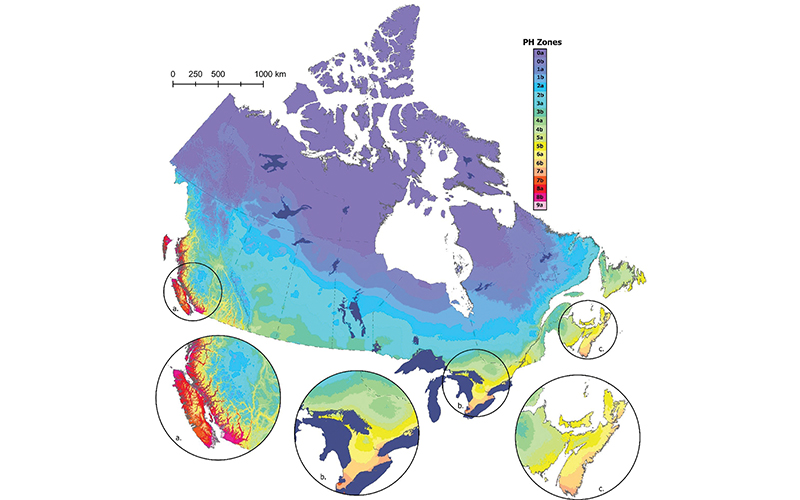
The most recent update to Canada’s plant hardiness zone map was a bit of a non-event for local gardeners. While some regions in Western Canada saw their ratings change by as much as two full zones, the Creemore area remains at zone 5b. Gail Crocker, of the Creemore Horticultural Society, says there was a disappointing lack of information available when the new ratings were issued in July 2025. One change she has observed is the different pests moving into our area.
“One of the most noticeable effects of milder winters and warmer temps is that pests are moving northward,” said Cocker. “We are now dealing with, or have risk of spotted lanternfly which poses a grave threat to grape and fruit tree producers. We can blame the increase in the tick population on the longer autumns and the rise in the average winter temperature. Long periods of sub zero weather used to kill off these insects, but now they are thriving.”
Another peril which is relatively new to our area is Oak Wilt, according to John Pedlar of Natural Resources Canada (NRC). Oak Wilt is a deadly fungal disease which leads to rapid leaf wilt, defoliation and often tree death. Pedlar is one of a team of NRC scientists based in Sault Ste. Marie. Their primary responsibility is to monitor climate data for the Canadian Forest Service. Plant hardiness mapping is not their day job, jokes Pedlar.
In Canada, a multivariate plant hardiness index was developed in the 1960s that incorporates several temperature- and precipitation-related variables. The original maps were created in 1960, using 30 years worth of climate data. Weather stations are not evenly spaced across the country, so scientists analyze available data then use modelling to “fill in the blanks.” Seven variables go into determining plant hardiness zones, including extreme temperatures, frost, snow, and wind. An overall value between 1 and 100 is assigned. Thirty years ago, the Creemore area had an index of 55. In last year’s update, that had risen to 58, still within the zone 5b bracket. Once the index reaches 60, the plant hardiness zone will increase to 6a. Pedlar says the local growing season has increased by 10 days over the last 30 years. There has been very little change in other factors, including a half degree change in minimum temperature.
Dan McKenney, another NRC scientist stresses that these are long term averages using the most recent data. Most areas around us have changed since the last maps were issued in 2015. The fact that Creemore remains largely unchanged may be due in part to the sheltering effect of the surrounding hills and the moderating effects of our proximity to the great lakes. Of those areas which have seen a change in rating, roughly 80 per cent have shown an increase in hardiness zone. People often think of increases in hardiness zones as a positive thing, allowing for a broader range of plants that may thrive in a given area. Heat loving plants that were once considered unsuitable for certain regions are now being successfully cultivated. Conversely, species which have traditionally done well in our area may be threatened by changes in temperature and precipitation.