Former Director of Air Navigation Services and Airspace reflects on 9/11 leading up to the 25th anniversary of the day that changed air travel and brought out the best in Canadians
A Simcoe County resident who had a key leadership role on 9/11 says the 25th anniversary evokes compassion for the victims and their loved ones, but also immense pride in his staff and fellow Canadians who made thousands of people stranded in a foreign country feel welcome.
Douglas Mein was serving as Transport Canada’s Director of Air Navigation Services and Airspace when two hijacked planes were flown into the World Trade Centre towers in Manhattan on Sept. 11, 2001.
On the 25th anniversary, Mein said his thoughts are with the 3,000 victims of the attacks.
“These are the people that I feel so bad about but at the same time I feel very proud of my staff and my fellow Canadians,” said Mein. “It was very well handled not just by Transport Canada but by the people of Canada especially the people of Newfoundland and Eastern Canada. It really brought out the best of people.”
Self described as an ambitious young man with a passion for radio, Mein had quickly climbed the ranks to represent the Minister of Transport and to execute his responsibilities under the Aeronautics Act.
He was in Edmonton the morning of Sept. 11, 2001 for a meeting when he started to get numerous calls on his cell phone. It was his first day back at work after a summer leave so he thought maybe his colleagues were having some fun with him, or there was a serious plane crash involving a Canadian plane. No one could predict how serious the situation would turn out to be.
As the enormity of what was happening in New York and the uncertainty around the scale of the terrorists’ plans, a NOTAM (notice to airmen) was issued. All planes were instructed to land at the nearest suitable airport.
Then Minister of Transport David Collenette wrote in a booklet titled Four Days in September, “With my approval, we did something no Canadian government had ever done — we essentially shut down our country’s entire airspace by ordering aircraft out of the skies, and not allowing any to take off. The department instructed NAV Canada to order 270 flights over the Atlantic to turn around and go back to Europe. We had NAV Canada direct another 224 flights with more than 33,000 passengers to land at Canadian airports.”
After all aircraft had been grounded, Mein and three of his colleagues had to get back to Ottawa so they entered Canadian airspace in a small jet, a Cessna Citation, that had been dispatched from Yellowknife to fetch them. He said the airwaves were eerily silent.
“Normally there is a lot of chatter,” said Mein, but there was nothing except one final call from a plane out of Tokyo that, heeding the NOTAM, was making its final call to land at the airport in Calgary.
“It was so surreal,” said Mein.
It was then that he heard something he thought he would never live to experience, an ESCAT was issued – Emergency Security Control of Air Traffic. The call reserved for times of war meant that NORAD had taken control of the skies over North America.
When they reached the Situation Centre in Ottawa it was like walking into a wake, said Mein, “Everyone was looking at their shoes.”
He said over the next few days a coordinated team effort took shape to rewrite the laws of the sky and get planes back in the air.
“I had a lot of authority and I never knew I would ever have to use it but I did,” said Mein, commending his team for their work.
CATSCA – The Canadian Air Transport Security Authority – was the direct result of 9/11, creating government oversight for increased airport security.
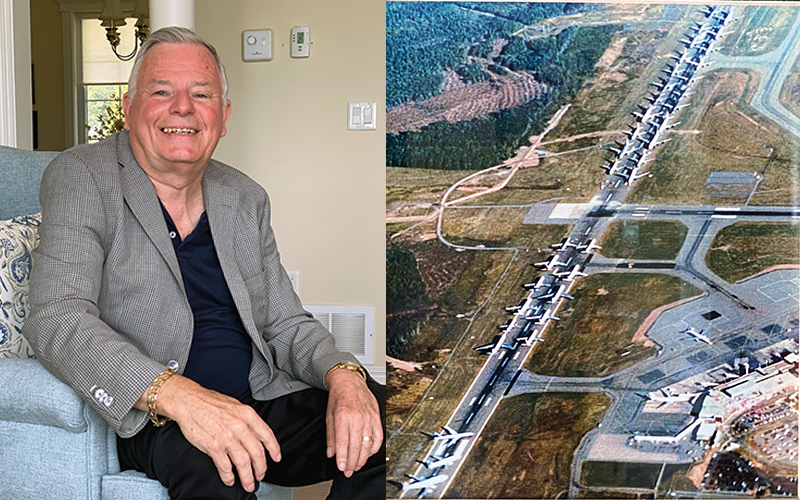
Mein is particularly proud of the way Canadians responded to thousands of stranded travellers, often arriving in small towns and cities, with sincere hospitality. Halifax, Nova Scotia and Gander, Newfoundland took 40 and 33 planes respectively.
“I did my job shutting down the airports but they did their job as human beings,” said Mein. “They opened their homes and they opened their hearts.”
The same happened in what Mein describes a “high drama” situation when two 747s flying over the pole from Korea were forced to land in Whitehorse. Mein can only surmise that a language barrier caused the pilots of the planes to fail to respond accurately to security protocols.
“We had to assume they were hijackers,” said Mein. “We had to assume the worst that any of the 224 planes could be hijacked.”
He describes chaos in the small city of Whitehorse where a high police presence and closed schools caused panic and resulted in a traffic jam.
The planes were being escorted in by CF-18 fighter jets and RCMP officers with sniper guns had been positioned on the roof at the airport.
“Everyone is spring loaded,” said Mein.
One by one every crew member and passenger was thoroughly searched before being cleared and security officials were assured there was no threat. The passengers were quickly taken in as guests of the people of Whitehorse.
“It all happened so well and so beautifully and I think the same thing would happen if it happened today,” he said.
What Mein’s colleagues didn’t know is that the reason he had taken a summer leave in 2001 was due to a mystery illness. The stress he endured in those first few days back on the job exacerbated his symptoms. In 2002, after many visits to the neurologist and a series of tests, he was diagnosed with primary progressive multiple sclerosis.
Mein recalls his doctor asking, “Are you in a stressful job?”
He was advised to retire if possible. Instead Mein was grateful for an offer to work from home, providing input, policy advice and joining meetings when possible, which he did until fully retiring in 2005.
He describes 9/11 as his personal war story, and one he says he is privileged to have been a part of.
Starting out as a boy with a passion for ham radio and Morse code, he set out to be a radio operator or an air traffic controller and retired with a 33-year career with the department of transportation, which included being Canada’s representative on the Air Navigation Commission (1989-1996), started at the age of 36. He was eventually tasked with setting up the department that would handle 9/11.
He said, “I wasn’t the world’s saviour or anything like that but I was happy to be in a position where I had authority to make a difference.”
On Friday he will be watching the special news coverage from his home near Rosemont.
“Having lived it myself it always brings good memories because I believe that this is one of Canada’s finest moments and I’m not just talking about Transport Canada, I’m talking about Canada and I would hope that our American friends south of the border might take that into account during the current political debates that we’re having over trade,” said Mein.
“I’m so proud to be a Canadian in that regard. This experience taught myself and my colleagues to have a different outlook on life.”
He uses an analogy of using the good China.
“This has taught me that life is fleeting. It’s so special. It’s so vulnerable sometimes and it’s very important to be grateful what you have," said Mein.
“My outlook on life is celebrate what you have right now. And use the good China.”
Photo: Mein’s archive includes this aerial photo of 40 aircraft stacked on the runway at Halifax Stanfield International Airport on Sept. 11, 2001. The diverted planes were carrying 8,000 passengers, that residents of the city welcomed with open arms during their unexpected four-day layover.