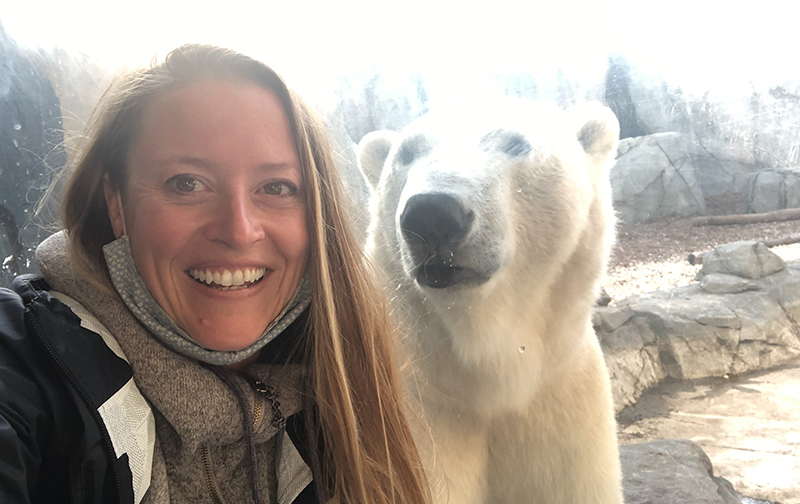
Arctic TV shoot offers career highlight
Jacquie Rushlow said it was a no-brainer for her to join the crew of Arctic Vets, a new documentary series airing on CBC, given that it is about two things very close to her heart: animal rescue and climate change.
The show follows the professionals who rescue, treat and protect the animals of the Arctic.
Arctic Vets was filmed from September to November, when two units travelled north after testing negative for COVID-19. The show follows the staff and animals at Assiniboine Park Conservancy in Winnipeg, but also features the work of Polar Bears International, Wildlife Haven Rehabilitation Centre, and Manitoba Conservation’s Polar Bear Alert Program, which safely relocates bears that come too close to town in order to avoid conflicts with the human population.
As story producer, it is Rushlow’s job to find the narrative that connects the viewer to the story. There is a lot of advance planning to ensure the crew can tell the best story but they also have to be highly adaptable to spontaneous situations.
“When you are working with wild animals you have no idea what you are going to get,” said Rushlow.
In Episode 2, Polar Bears International finds a rare set of healthy polar bear cub triplets heading to their winter hunting grounds with their mother, something that researchers say they haven’t seen in decades. Rushlow said this incredible mom had kept all three cubs alive for the seven months that she had spent outside their den.
Researchers were looking to measure the body composition of the animals using a thermal imaging camera, to assess their overall health and how much energy they are expending, when they got lucky.
She said what happened next is literally the highlight of her career.
“We’re sitting there watching the mom and three cubs, for probably two hours in this crazy tundra buggy on the tundra and then Polar Bear International’s Geoff York has a radar system on the buggy and says, we’ve got one coming in from the other side,” recalls Rushlow.
She said the tension was high, as there is a probability that the incoming male polar bear would eat the cubs.
“They’ve been in a walking hibernation now for four months, not being on the ice and not eating, their biggest predator is other bears,” said Rushlow.
She said they were praying that nature wouldn’t take its course right at that moment. Luckily, they got their happy ending because the male polar bear was more curious about the crew in the tundra buggy than the cubs, giving them an opportunity to escape while the researchers got some good thermal images of the male.
Throughout the 10-episode season, viewers meet wolves, arctic foxes, lynxes, harbour seals, owls, swans, and bald eagles.
Rushlow said the experience has given her a greater appreciation for conservation efforts and a better understanding for circumstances when wild animals benefit from human care. She said there is value in rescuing animals that otherwise wouldn’t be able to survive in the wild and making them ambassadors for wildlife and environmental protection.
“For me, it was so great that we always got to tell stories and educate with the undertone of climate change,” said Rushlow, who also owns Creemore Refillery, a plastic-free shopping experience.
Arctic Vets airs on CBC on Fridays at 8:30 p.m. Catch up on past episodes at CBC Gem.