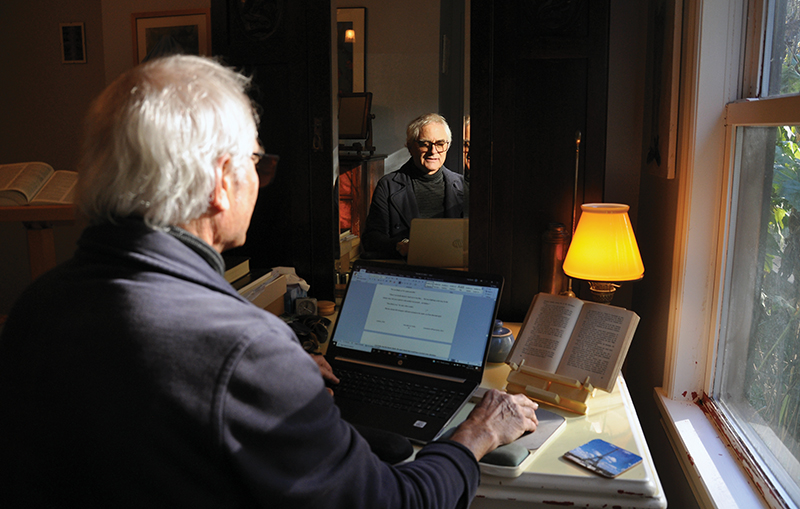
Translator continues to delve deeper in Giono works
In order to properly translate the poetic writing of beloved French author Jean Giono, Paul Eprile is always striving to go deeper, probing the layers of the prose to squeeze out every ounce of meaning, place and time.
What started out as a personal exercise to immerse himself in the works of the author, who until recently has not been widely translated and therefore inaccessible to English language readers, Eprile has now completed three published translations of Giono’s work. The Open Road, a translation of Les Grands Chemins, has just been released by New York Review Books (NYRB) Classics.
“Translation is a meticulous labour, patient and passionate at once. It’s not within everyone’s reach to translate Giono,” writes Jacques Le Gall in the introduction. “Is it possible to replicate the countless nuances in the figures of speech – whether familiar or highly colloquial – that pepper the dialogue? Is there a way to translate the ‘pulse’ or the ‘gestalt’ of certain pages?”
Eprile, a Dunedin area resident who has also translated Giono’s Hill and Melville, is a self-described Francophile who has studied and travelled in France. He tells a story of browsing in a French bookshop when he first discovered Giono. It may have been the cover that first caught his eye but he said its contents swept him off his feet because it was so unlike anything he’d ever read before.
“I just became more and more enamoured of him,” said Eprile.
He went back and began devouring Giono’s entire catalogue. He started translating Hill with the intention of forming a deep understanding of the text that is rich with idioms, and peppered with sayings and expressions, as well as descriptions of the natural world and the people who live in the Provence region of France where the books are set.
The Open Road is set in the south of France in 1950. The narrator is a solitary vagabond who walks through the region between northern Provence and the Alps picking up odd jobs. Eprile said the narrator, who is never named, longs for human connection and is both repulsed by and attracted to a companion he picks up along the way, referred to only as ‘the Artist’, a cardsharp and con man.
Eprile said his is the first translation in English and possibly in any language, and was not without its challenges.
“It’s essential to find that voice and have it be convincing and consistent,” he said.
Finding the “natural voice” is what helps to bring the reader into the story, even though they are reading it in a different language, he explained.
In order to do so he would sometimes spend days working out the intended meaning or sentiment of a phrase or passage, using all of the tools of the trade; dictionaries and the internet which has been a big help.
“It’s very hard work, mentally, but when you find it, it’s so satisfying,” said Eprile, who is now working on two books by Collette, Chéri and the sequel La Fin de Chéri, which will be published in one volume by NYRB in 2022.
Eprile will be participating in a free virtual event on Nov. 11 hosted by Community Books in Brooklyn entitled On Jean Giono with Bill Johnston, translator of Ennemonde published by Archipelago Books, in conversation with Edmund White about Jean Giono and a new wave of translations of his work into English. The event runs from 5 p.m. to 6 p.m. To register, visit www.communitybookstore.net and find links on the events calendar.
The book will be available at Curiosity House Books in Creemore.