Ag edition: Rotational grazing
“It’s a good time to be a beef farmer,” said Jim Whitley. “Grazing, and cattle in general, are back in vogue.”
After a period of bad press, cattle are now being viewed as beneficial to land stewardship. Also, due to a number of factors, retail demand for beef is the strongest it has been in 40 years. Low cow inventory across North America, combined with high consumer demand due to changing dietary trends toward dense proteins, and a growing population, have caused the price to soar to a 35-year high of $742 per head.
With his family, Whitley operates a 40-head commercial Charolais cow- calf herd on 136 acres in Avening.
They background half of their calves and finish the remainder for the local freezer beef market. Whitley works across the country as a Verified Beef Production Plus (VBP+) program auditor for Beef Farmers of Ontario, where he sits on the board as the cow- calf director.
He is part of a grazing network group and has just completed a multi-year research project being done by the University of Guelph and the Ontario Ministry of Agriculture, Food and Agribusiness to calibrate a rising plate metre – a tool used to measure pasture height and density – as a baseline for pasture yields. The goal is to benchmark pasture utilization rates on Ontario beef, sheep and dairy farms. Throughout the process Whitley has become more and more of a believer in the practice of rotational grazing. His goal is to go 180 days without supplemental feeding, extending the grazing season into the spring and fall.
Some farmers graze their cattle year-round. Whitley said there are some savants in the grazing community who are wholly tuned in to their herd’s movements and behaviour, ensuring they are well fed by analyzing manure, water intake and even counting the number of times a cow chews its cud.
Rotational grazing is beneficial to the farmer because it reduces feed costs, controls erosion on sloped land, liberates them from feeding schedules and makes for cleaner and healthy animals. Even as a knowledgable fourth generation farmer Whitley said pastures require courage and discipline.
Whitley is working with Brent Preston at the New Farm Centre near Dunedin, which earlier this year put out a call for landowners interested in collaborating with farmers by allowing access to their dormant lands for grazing as a way of restoring soil health and revitalizing pasturelands as part of a Regenerative Transition Support Program.
Initial interest was higher than expected with 61 sign-ups, resulting in about a dozen landowners who are seriously considering fencing and prepping their land for grazing.
“We were happily surprised by how much interest there has been,” said Preston, who has been working on the promotion of rotational grazing with Farmers for Climate Solutions.
He said rotational grazing has been gaining traction across the country. He sees it as one of the few ways that young people can get into agriculture in an affordable way in this area because of the high price of land.
“You can use rented land and with this kind of grazing the farmer does not need to invest in a lot of expensive machinery,” said Preston.
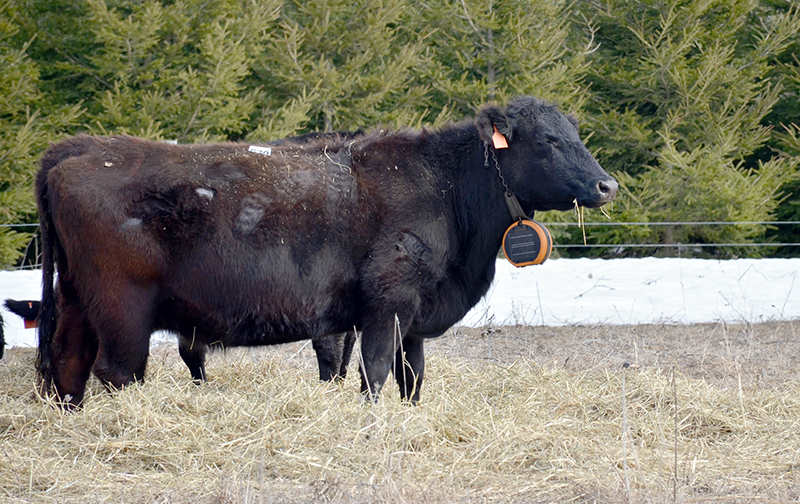
To aid with rotational grazing, which requires precise control of the animals’ movements, both Whitley and Preston are using e-collars, an emerging technology that is gaining popularity. The collars restrict the cattle’s movement, similarly to an invisible fence. With a natural inclination to advance, the e-collars restrict the herd by letting it move ahead bit by bit.
The e-collars, worn around the neck and weighing about 30 pounds, allow the farmer to precisely control the animals’ movements. Whitley said because it is possible to set up exclusion zones, he is able to keep the animals away from streams, trees or trails, which makes it more appealing for landowners to open their properties to rotational grazing.
Strict control of the herd’s movements helps control the growth of the pasture. “If you don’t control the cattle’s movements they will wander around eating the most delectable plants,” said Whitley, adding that ideally the cattle can access the grass when it is about 10 inches tall because they eat by wrapping their tongue around the plant and tearing it off, leaving it at about four inches.
There is a lot of interest in this type of technology as demonstrated by high demand for federal funding that could be applied to e-collars. The Government of Canada first announced in 2021 a $ 704.1-million On-Farm Climate Action Fund to help farmers tackle climate change. Demand in Ontario’s allocation was immense and available funds were snatched up within 90 minutes.
Grassland ecosystems
“Grassland ecosystems don’t exist without grazing,” said Preston. “It’s the grazing that maintains the ecosystem as a grassland. If you want the environmental benefits from healthy grasslands – carbon sequestration, biodiversity, flood control and droughtmitigation – you need animals for that system.”
Rotational grazing imitates natural systems.
“Way back we had giant herds of bison on the prairies. The way the grassland ecosystems evolved with these big herbivores is you’d have periods of intense grazing with big densely packed herds of animals followed by long periods of rest and recovery when the grass could regrow,” said Preston. “All we’re doing with rotational grazing is imitating that system.”
The grasses and plants benefit from the manure, urine and even from being trampled. It stimulates the plants to grow deep compact root systems and store lots of energy from the sun underground.
The process is a form of carbon sequestration, removing it from the atmosphere and using it to feed the microbes they rely on to grow. Soil carbon capture (or sequestration) works by transferring atmospheric carbon dioxide (CO2) into the soil through photosynthesis, where it is stored as organic matter. Plants absorb CO2, convert it into sugars to feed their roots and soil microbes, and leave behind carbon-rich organic matter when they die or shed roots, effectively storing the carbon.
As a result the land is more resilient to adverse weather conditions. It can absorb rain better and hold moisture during droughts.
“It’s a way of building resilience against climate change and all the changes in the weather that we’re seeing,” said Preston. “It also stores a lot of carbon in the soil. A healthy grassland can store as much carbon as a tropical rainforest.”
Healthy pastures also support biodiversity by creating habitat for birds and insects, microbes and having a healthy mix of vegetation.
At one time, cattle were seen as a detriment to the environment.
Methane is a powerful greenhouse gas, said Preston, adding, “Cattle do produce methane, there’s no getting around that but we can mitigate the amount of methane they produce and get a whole bunch of other environmental benefits if we’re grazing them really carefully. A cow that’s grazing on really healthy, productive pasture just naturally produces less methane and the methane they produce is largely offset by the carbon that’s sequestered in the soil. And then we look at all the other co-benefits of having animals on the landscape.”
Trina Berlo photo: The New Farm Centre’s herd of Black Angus is wearing e-collars to control grazing.