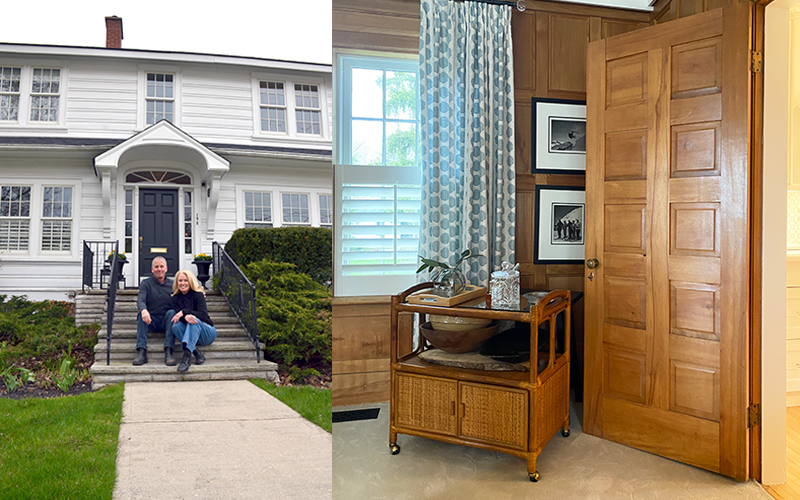
Home & Garden: Historic home built by lumber barons
Throughout their adult lives, Cam and Steph Fryer have never found a house that gave them that feeling of being home like the one they occupy on Mill Street. During their residency, going on three decades, they have been open to the idea of moving, but nothing could compare.
Having many connections to the Creemore area, Cam and Steph were well acquainted with the village. As newlyweds, they said they would come into town and admire the white house at 198 Mill St.
Steph said she loved the Dutch colonial revival architecture, defined by its symmetrical layout, sunroom, central doorway and a barn-like gambrel roof with flared eaves – although the curved roof on their house is illusional.
One day in 1996 they were having lunch at the tea house that used to be across the street and noticed a for sale sign on the lawn. Seeing that real estate agent Pat Prime was showing the house to perspective buyers, they asked if they could see it.
“We were just being nosey at the time,” laughs Steph.
The young couple had no plans to buy a house.
Prime agreed to take them on a tour.
“We felt like we were coming home,” said Steph. “We came out thinking, how do we make it work?”
Cam said they put in an offer with a long closing date so they could save up.
They purchased the house from Thelma Thomson, the original owner.
Greg and Thelma Thomson built the house in 1929. The Thomson family operated a successful lumber business. At the time, Greg was managing Peter Thomson and Sons Planing Mill, Creemore’s largest employer with a staff of 12. It was located on the south side of Francis Street and produced pine sash, windows, and doors, mainly for use in local homes and Base Borden during the 1940s, and baseball bats.
The house is trimmed with wood from the family farm in Mulmur, the burled birch panels are said to have been cut from a single tree, according to local history.
When the Fryers purchased the house it was 1,800 square feet with three bedrooms and one bath. Raising two daughters, the family was in need of more space so a plan to build a back deck in 2003 turned into a 1,400 square foot addition out the back. Always wanting to preserve the character of the house, they ordered custom made siding to match the unique bevelled two-width design. The Fryers say it takes a lot of paint to keep it looking good. A professional decorator, Steph is constantly tweaking and updating the interior but they have left the wood panelling in the dining room, the panelled stairs, banister and doors unpainted. In fact, the door to the cellar still holds Thelma Thomson’s chalk board and when they needed to update the kitchen, they agonized over removing a wooden banquette, a portion of which is now in the mudroom.
When the Fryers first moved in the house was constantly referred to as the Thomson house. As the years go by they hear that a little less frequently but in some ways it will always be the Thomson house to them.
Warmth of wood
With a strong local lumber industry, it’s not surprising that many of Creemore’s historic homes were built with impressive staircases and unique wood features.
On Elizabeth Street West, the Hentsch family, with the help of friend James Webster, is restoring the stairway as authentically as possible.
The house was built circa 1890 and still has the original trim and doors, with most of it having escaped the paintbrush.
When asked what drew them to the house when they bought it in 2020, Jessica points to the secret basement door that is inconspicuously built into the staircase paneling. The door leads to a stone foundation basement that serves as Devin’s music studio, storage area and rec room.
Last year they had the main level floors refinished and recently, Webster has been refurbishing the stairs and trim to match the rich colour that he said can only be replicated using traditional methods and products.
He learned his craft from his father, Glen Webster, who was an antiques dealer and refinisher in Primrose. His father was his first employer and he learned to appreciate the finer qualities of old materials.
“It’s a lost art,” said Webster.