Ag edition: Hydroponics
Cornucopia Farms is deliberately low key. Situated on Highway 26, just east of Stayner, there are no flashy signs proclaiming its presence but within three customized containers at this site, lives an experimental operation that may represent the future of farming.
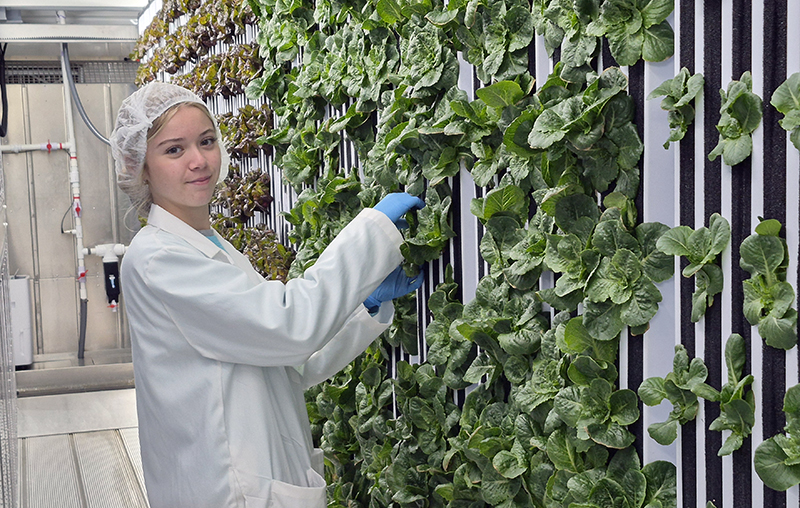
Farm operations manager Penny Towndrow said each of the three 320-square-foot containers is referred to as a farm. With advanced hydroponic technology, each farm can yield crops comparable to 2.5 acres of conventional farmland. And because the environment is strictly controlled to ensure optimal conditions, the growing season is year round. For example, the lettuce farm can cycle 10-12 crops per year.
Municipal zoning rules do not permit on-site retail so for now, everything they produce is either donated to local food banks or supplied to high-end restaurants. Towndrow said the hope is that produce from Cornucopia Farms will eventually be sold direct to consumers and at local farmers’ markets, in farm boxes and via subscription services. For now, they are focused on getting the farms up and running.
“The farms had been in storage since the original owner in Boston went into receivership,” she said. “Owners, Stacey and Susan Schacter are passionate about finding solutions to food insecurity. They bought the farms from the receiver and moved them to the Clearview Township location. We got them set up here in mid-November and started to get serious about growing in December.”
Towndrow said roughly 60 per cent of the food we eat is grown in other countries.
“Growing indoors locally means produce can be picked when it’s ripe and delivered to consumers quickly,” she said. “Because we’re growing indoors, there is no need for pesticides. I don’t even wash the greens that come from the farm because there is nothing harmful on them. Our produce is not certified organic because there is no soil involved. During ‘bug season,’ we use an air curtain to protect the crops and in the unlikely event we do get an infestation, we can simply increase the amount of water and heat, and get rid of pests naturally.”
Each farm uses about five gallons of water per day which is filtered and recycled. Energy consumption is a big expense. Towndrow said each farm uses roughly five to 10 times as much electricity as an average Canadian home heated with gas or about two to five times as much as a home with electric heat.
“We schedule growing with red and violet lights for 12-14 hours overnight, when electricity is most affordable, then during the daytime, when power rates are higher, we have just enough light in the farms for our staff to work. Down the road, we might be able to partner with a small data centre to use their C02 output to grown our plants,” said Towndrow.
“Plants spend two to six weeks on the wall,” according to Towndrow. “We stagger planting so there is a constant supply of plants ready for harvest. Because we are not affected by weather volatility, we will be able to offer restaurants and small stores stable supply and pricing. Whereas costs at the Ontario Food Terminal can vary up to 100 per cent per week, we will be able to offer price stability for several months.”
Currently, Cornucopia Farms has one farm devoted to herbs like sweet Thai basil, cilantro, parsley and mint. The two remaining farms are planted with fast growing greens. Towndrow said plans are in the works to add a fourth farm that will be devoted to mushrooms.
American entrepreneur Stacey Schacter, founder, president and CEO of VION Investments – a specialty finance company offering receivables portfolio purchasing and asset disposition, receivables-based funding, and valuation advisory services – has been studying hydroponic farming operations around the world.
“My vision is to learn what’s required to have small, local farms that work,” said Schacter. “We’d like to grow specialty crops and free up valuable farmland for things that can’t be done indoors. We know that there are medicinal native plants that haven’t been adequately studied because it is impossible to control growing conditions in the wild. With controlled environment agriculture we may be able to grow native plants like ramps which are at risk of over- harvesting.”
He said, “Power is a big challenge. In Europe, they’re using geothermal heat for hydroponic operations. We’d like to develop technologies like roof mounted wind turbines that can withstand Canadian weather.”
Schacter and his wife are in the process of applying for resident status in Canada. In the meantime, they split their time between Clearview Township and their home in the United States.
“We’d like to be able to grow enough to break even,” he said. “At some point, the business should be able to invest in more farms. Right now, I’m paying people to do my hobby.”
Currently, Cornucopia Farms employs eight staff, mostly part time. Seeing the potential for cooperative ventures with community groups, Schacter said the business is currently providing produce to food banks in Collingwood and Creemore, and he would like to expand those relationships.
Bonnie MacPherson photo: Jenna McCannell working at Cornucopia Farms.