Ag edition: Women in agriculture
Growing up in Chesley, Taylor Legge never imagined a career in agriculture. She was – and still is – passionate about climate change, and headed off to the University of Guelph to study Environmental Science. One year into the program, Legge had an epiphany. She thought she could do more to impact climate change working directly with farmers, and transferred to the Bachelor of Science/Crop Sciences program.
After graduating in the spring of 2025, Legge signed on as an agronomist at Holmes Agro in Stayner. She is one of a new generation of women in agriculture.
“Out of my graduating class of 160 people, roughly 60 per cent were women. The majority of my co- workers at Holmes Agro are women. Currently, there are more women on the consulting side than in operations,” said Legge. “I am seeing more and more women working in agriculture, but so far, there are not a lot of older women.”
Legge said since so many farms are family businesses, there is a lot of tradition.
“My family had a feed lot and beef operation which my younger brother now runs together with my parents,” she said. “My parents never pushed me toward a career in agriculture. I came to it later out of my own interest. I think you have a better understanding of all the challenges involved if you do it because you love it.”
On a typical family farm, she said, there is no HR department, “So you become the accountant/customer service rep/ technician. It’s not just a career. It’s a lifestyle.”
The Ontario Federation of Agriculture puts female farm ownership at around 30 per cent. Legge said there have been big strides toward equality for women in agriculture in recent years.
She said the situation is better here than in developing countries with women leading the way in innovative, science-based approaches to agriculture. But on a typical farm, there is still lots of unpaid, undervalued work done by women. She said she has no interest in actually becoming a farmer, but is excited to be doing cutting edge work.
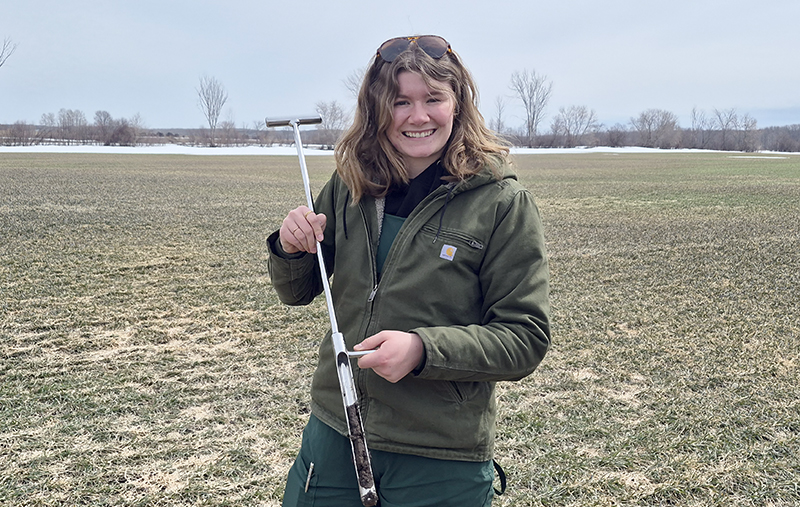
“My role is half sales, half consulting,” she said. “I assist my farmer clients with crop planning and soil sampling to develop fertility plans. We recommend and provide fertilizers and crop protection products. Women in agriculture have a lot of knowledge and expertise. I’ve had to work hard to earn credibility. Perhaps part of that is because I’m a woman, but a big part of it is being new at my job.”
While she was a student at the University of Guelph, Legge headed a group called Women in Agriculture. She keeps in touch with many former student colleagues, who are employed in a variety of roles throughout the industry.
“I would say a quarter or less of my graduating class actually became farmers,” said Legge. “Farming has become highly technical and more knowledge based, which is creating a lot of opportunities for women with the right skills.”
Legge is one of only two women directors on the board of the North Simcoe Crop Improvement Association.
“I’m so proud and lucky to have grown up on a farm and to now work in agriculture,” she said. “I think it’s a very rewarding industry to work in, and women are the backbone – and have always been. We have more opportunity now than ever to work outside of primary labour, as agriculture calls for so much science, business, and other skilled labour forms. As an agronomist I use my university degree every single day. In Clearview Township we are uniquely positioned for innovation in agriculture and that women have a huge place in that. As developing countries get better at producing commodity crops like corn, soybeans, and wheat, it gives us an opportunity to leverage our climate in Ontario to grow higher value food crops and to do something different. We’re lucky at Holmes Agro to work with producers in Simcoe County who grow apples, potatoes, root vegetables, cabbage and broccoli, food grains, and edible beans – just to name a few. Coupling that with the opportunity for agritourism, we have a huge opportunity for value-added agriculture and I do think women will be at the forefront of that. Through my time as Ontario Queen of the Furrow, being a student at Guelph, and working as an agronomist, I could tell you discouraging stories about being a woman working in agriculture; but I could also tell you so many great stories about the community and opportunity that it offers. Globally, different areas of the world are not as fortunate as we are, but 2026 is a very exciting time for Ontario agriculture.”
2026 declared International Year of the Woman Farmer
2026 has been designated as International Year of the Woman Farmer by the Food and Agriculture Organization of the United Nations hoping to raise awareness of the role of women in agri-food systems and the challenges they face, including land tenure, financial and technical constraints, and limited access to services and education. It also seeks to encourage policies and investments that empower women in agri-food systems and to promote greater synergies among international initiatives supporting women farmers. According to The United Nations, “women play essential roles across agri-food systems, producing, processing and trading food that sustains families, communities and economies. Yet their contributions often go unrecognized, and persistent inequalities limit their access to resources, opportunities and decision making.
“The International Year of the Woman Farmer highlights these realities, calls for collective action and increased investments to close gender gaps, strengthen women’s livelihoods and promote their leadership across agri-food value chains. By advancing gender equality and creating conditions for women and girls engaged along agri-food value chains to thrive, the Year contributes to building fairer, more inclusive and sustainable agri- food systems for all.
“Empowered women farmers are key agents of change in transforming agri-food systems. Closing gender gaps in access to and control over land, finance, technology, education and decision-making enhances the well- being of women and their households, boosts productivity, strengthens resilience to climate change and drives progress towards the sustainable development goals.”
Bonnie MacPherson photo: Taylor Legge demonstrates the use of a probe to take a soil sample. Legge says soil sampling is at the root of everything she does. Samples are analyzed at a lab in London, Ontario to determine base fertility levels. Agronomists then determine optimal soil additives to ensure peak productivity.