Ag edition: Crop protection
Crop protection is the science and practice of managing weeds, pests, diseases, and other environmental stressors to safeguard agricultural crops, ensuring high yields, food security, and economic viability through the use of chemical, biological, and cultural methods to maintain crop health, quality, and productivity.
In an agricultural sector farmers rely on the expertise of crop advisors like Lydia Noordegraaf who help them develop crop plans and monitor crops from start to finish. Even though most crop plans are decided on in the fall things can change, she said, depending on the markets, crop rotation plans, and a number of other factors.
Noordegraaf is a certified crop advisor for Holmes Agro, an agricultural crop inputs retailer with a location in Stayner. She grew up on a farm just down the road and did a high school co-op placement at Holmes Agro, which led to summer jobs. After college she joined the staff and is now 10 years into her career, and has a farm of her own across the street.
When asked what draws her to the job, Noordegraaf said it’s the relationships she forms with her customers and helping them to succeed.
Success is ultimately measured in crop yields. Holmes Agro has a goal to increase crop production by 150 per cent by 2040 across its customer base, something Noordegraaf says is achievable based on some data.
Crop yields show a clear upward trend. In the past 20 years yields for corn, soybeans and winter wheat have increased by 20 to 40 per cent. This has been achieved through advancements in farm equipment technology, crop inputs like fertilizer, seeds that are genetically designed to tolerate drought and disease, fungicides and herbicides, timing and the weather.
Noordegraaf said a lot of research and thought goes into choosing a variety that is right for a certain field. The growing season is measured in crop heat units – the amount of heat required for crops to reach maturity – with Clearview Township being in the 2,600 to 2,800 range.
Every crop requires certain nutrients to grow, said Noordegraaf. The big three macronutrients in fertilizer are nitrogen, phosphorus and potassium. Crop advisors make sure the soil is in balance and optimized for nutrient absorption. Laboratory soil testing measures the soil’s base fertility analyzing nutrient content, pH, and organic matter to determine nutrient availability for plant growth. Each crop has a removal value for determining fertilizer application rates and managing soil fertility, as failure to replace these nutrients can lead to declining soil test levels over time. Noordegraaf helps clients determine the best fertilizers to replenish the soil based on the farmer’s yield expectations and soil type.
***
Marieke Patton said she fell in love with agriculture while growing up on a small farm in Essa Township.
It wasn’t until she got to the University of Guelph that she discovered crop farming and started to learn about all that goes into crop protection and boosting yields.
While at school she got a summer job working on a Bayer research farm.
“I was blown away by the science and what it could do,” said Patton, who was part of one of the company’s first herbicide trials. “I was really impressed.”
She continued to work there in the summers and went on to be part of the sales team for more than 20 years, working with the products from the development stages, before taking over BJS Farm Supply in Stayner in July and rebranding it Clearview Ag.
The seed brand DeKalb is a prominent agricultural brand specializing in high-performance seed, which has been a subsidiary of Bayer since 2018 following Bayer’s acquisition of Monsanto.
“It’s pretty amazing how much research goes into it,” said Patton, adding that it can take up to 10 years for a new product to go to market. On a research farm, a new product is tested first on a small scale and then scaled up before being tested on a working farm. The test plots are measured against the existing crops and then weighed at harvest time. Each cycle takes an entire year and there are no guarantees the product will ever be marketable.
Patton said success is measure in yield, standability (strong stalks), relative maturity (maturity reached during the available growing season based on crop heat units, calculated based on daytime temperatures versus nighttime temperatures).
“With agriculture you only get one cycle per year, one chance to evaluate,” she said.
As a result yields have gone up significantly, especially for corn and soybeans.
“It’s about getting a lot of things right,” said Patton. “It’s all very sophisticated.”
Crop protection is about using products that will make the crop resilient to disease, pests, funguses, weeds, and drought.
“Otherwise you would have a downgraded product that would result in less revenue and would take it out of the human food supply,” said Patton.
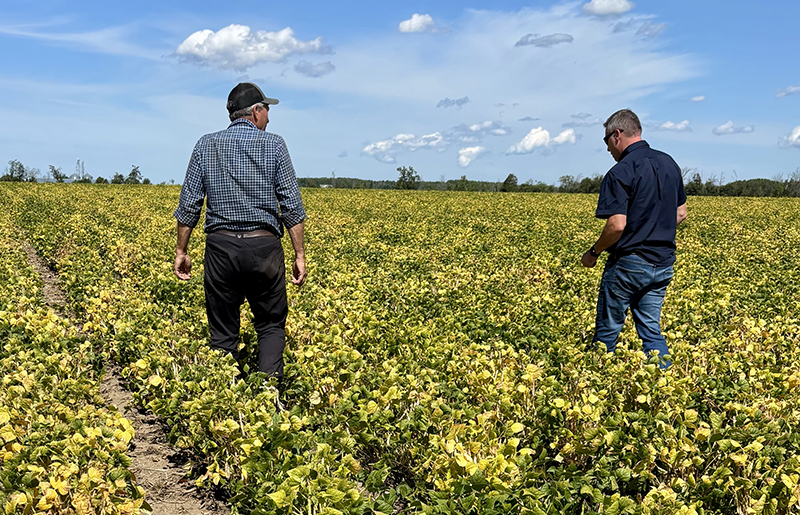
She said she decided to take over the retail store because she really enjoyed working with the farm community. Her services include “scouting,” where she walks the fields to check on the health and vitality of the crops. For example, Patton said winter wheat that can be seen coming up in the spring is susceptible to fusarium head blight, or “scab,” a mold that can cause wilting. A biofungicide is used to colonize the root systems, where it competes with harmful pathogens for resources, thereby reducing their populations. The fungus produces enzymes and metabolites that fight plant pathogens, such as fungi, bacteria, and nematodes.
When developing a plan, Patton will take into account the growing conditions, farm history, location and weather patterns, in an attempt to get the best quality crops. She may help farmers choose the right seed based on yield goals, risks and crop rotation.
Farmers place their orders the previous fall and the warehouse at Clearview Ag is full of pallets stacked with seed orders ready for spring planting. So sometimes she is working a year ahead, although she also responds to emergencies whether its stripe rust on winter wheat, tarspot on corn, or spider mites on soybeans. Threats may be identifiable with the naked eye, or samples are sent to the lab for analysis.
“It’s complex,” said Patton. Farmers care about the environment. They’ll invest money into the acreage that they might not see back but they know they are paying it forward to the next generation.”
“Herbicides get a bad rap but there’s so much benefit,” she said. “You have to look at the risk- reward. These products are expensive so farmers aren’t going to overuse them.”
Contributed photo: Homes Agro sales agronomist Scott Caughill, checking a field of black beans with our customer, for desiccation timing.